An essay written as if by Susan Sontag
“Contrast and Harmony: The Metaphysics of Visual Language”
An essay written as if by Susan Sontag
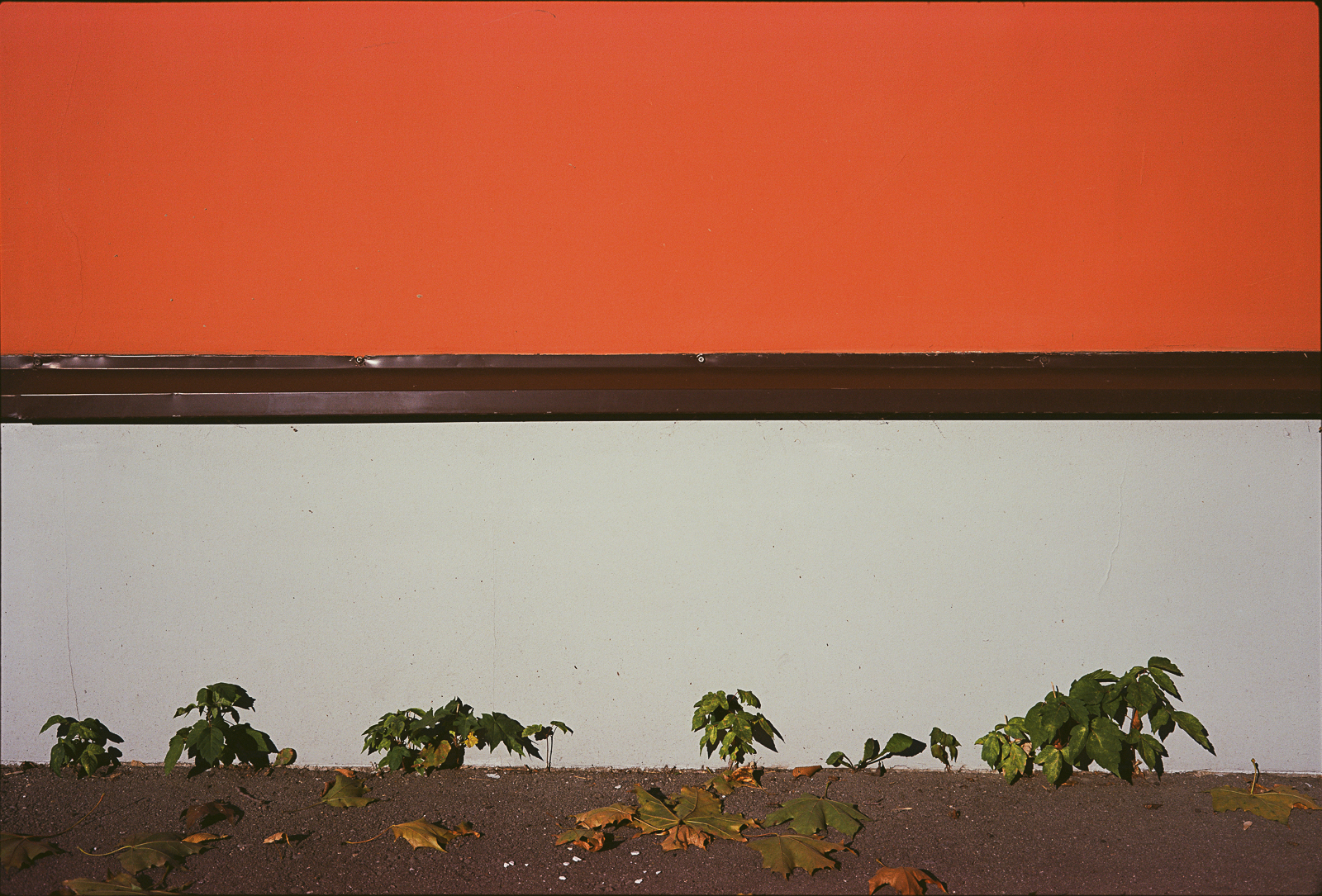
Looking at this photograph, I am involuntarily drawn into a dialogue between art and reality. This is not merely an image of a wall, colors, and fallen leaves. It is an expression of the metaphysics of visual language, through which photography speaks to us, even if we are not prepared to listen.
Every element of this composition is a statement, a gesture. The red field, piercing and vibrant, asserts its strength, its dominance. Yet its intensity and insistence are balanced by the greenish calm of the lower segment, as if a fragment of nature has infiltrated the sterile space of urban geometry. The horizontal line—a dark barrier between the two colors—becomes not just a boundary but a point of contact, a space where the human and the natural meet to form a new, strange alliance.
Photography is always a choice: focusing on details, stripping away context, replacing the vast with the small, the complex with the simple. These are the tools through which the photographer crafts their statement. In this case, the choice is minimalist: just color, just structure, just nature breaking the rhythm of human strictness. The leaves, with their organic chaos, and the sprouting plants stand against the system, reminding the viewer that nature is not merely a backdrop. It actively intervenes; it resists.
I cannot help but recall writing once: “Photography is not just the reproduction of reality. It is interpretation, and, therefore, it is a moral statement.” Here, the moral statement speaks to boundaries—of power and submission, geometry and the organic, humanity and nature. Yet the photographer skillfully avoids sentimentality. There is no call to return to nature or reject progress. On the contrary, this work is about coexistence, about confrontation that does not destroy but creates something new.
This photograph speaks to us in the way that the canvases of Mark Rothko or Donald Judd might. Their abstract fields of color are meditations on the state of being. Here, we see the same meditation, but transposed into an urban landscape. Yet, unlike their works, a narrative emerges. The leaves, the young shoots of plants, weave themselves into the story, creating the texture of time.
Photography has always been and remains an art form that balances between reality and symbolism. It invites us into a world that is simultaneously real and wholly artificial. This is its magic. We see a wall, earth, and leaves, but in truth, it is something more. These are symbols. Red is energy, ambition. Green is calm, nature. Their collision is life itself.
And so, in this simple scene, the photographer compels us to reflect. Perhaps what we perceive as order is merely a thin veil under which nature slowly and inexorably reclaims its place. Perhaps this work is not about contrasts but about harmony—harmony that we must learn to see in these seeming oppositions.
Photography never provides answers. It asks questions. It leaves us alone with ourselves, urging us to seek meaning where none seems to exist. And this is its greatest power.
Fujica 6×9
#PosthumousGaze
 Maxim Ksuta