Maxim Ksuta

russian artist, contemporary art, sculpture, installation, photography

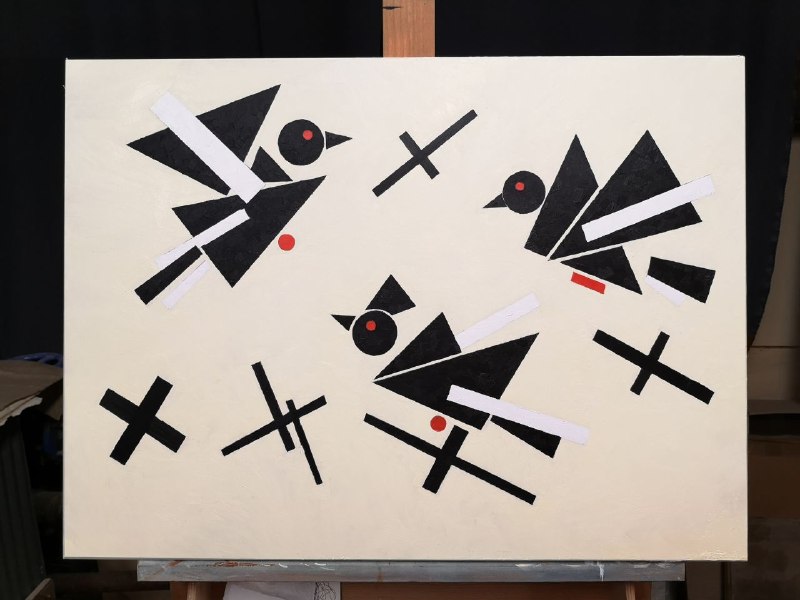
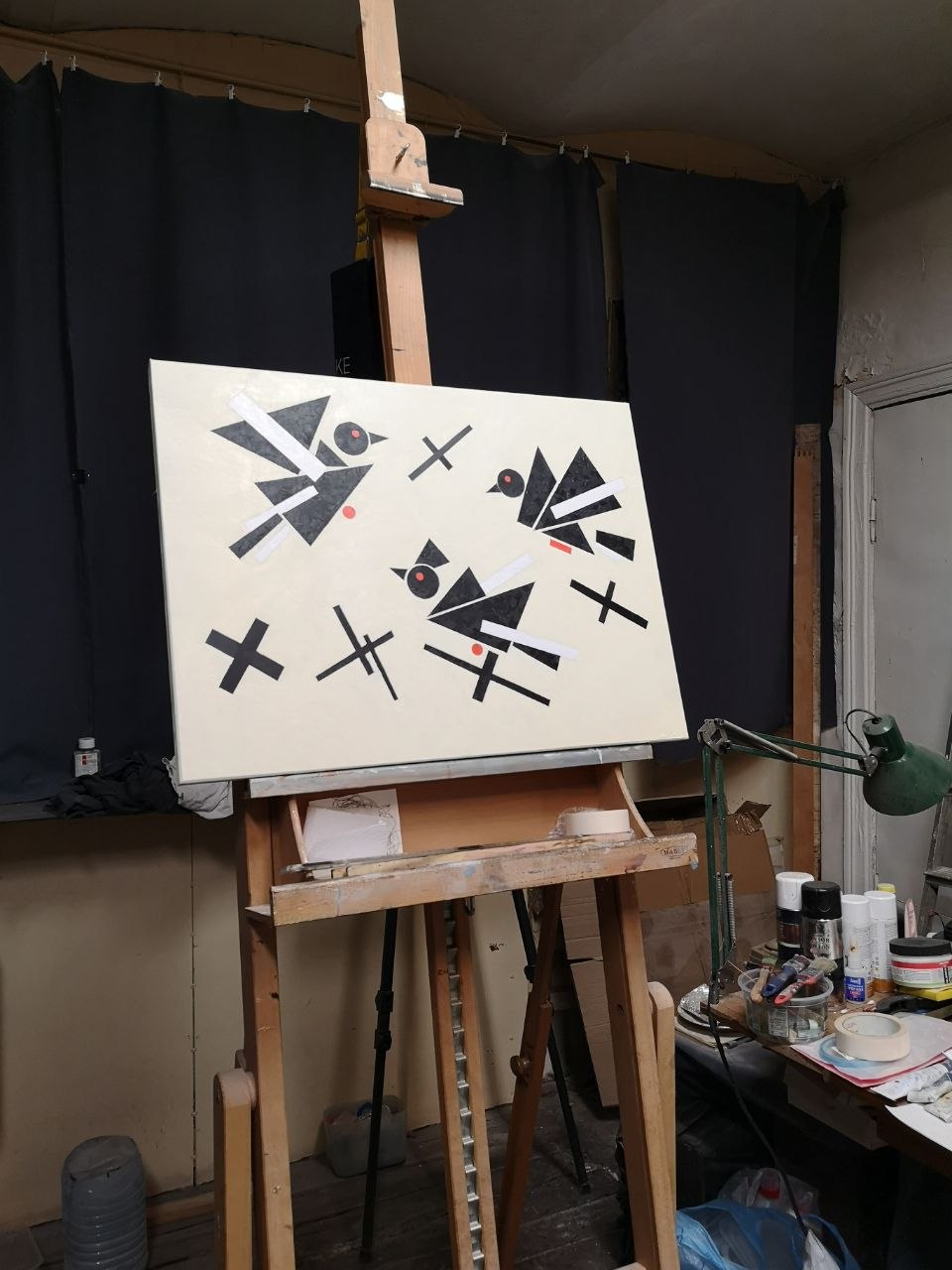
Супрематические сороки

Иногда мне кажется, что эту работу сделал не я, а какое-то упрямое пересечение внутри меня — между желанием дойти до чистоты формы и невозможностью отпустить живое. Я начинал с почти аскетического намерения: белое поле, чёрные конструкции, никакой лишней интонации. Хотел приблизиться к состоянию, где форма существует сама по себе, без опоры на мир.

Но в какой-то момент в этой конструкции появились сороки.

Не как образ, не как иллюстрация — скорее как сбой. Чёрные треугольники вдруг начали складываться в крылья, круги — в головы, линии — в траектории движения. И я понял, что это уже не геометрия в чистом виде. Это что-то, что хочет жить.

Сорока — странная птица. Она некрасивая и красивая одновременно. Она шумная, наглая, внимательная, всегда на границе между порядком и хаосом. И, наверное, именно поэтому она так точно легла в супрематическую структуру. Потому что супрематизм — это тоже про границу: между предметом и отсутствием предмета, между миром и его исчезновением.

Белое поле здесь для меня не космос в строгом смысле. Оно слишком тёплое, слишком земное. Это снег. Пространство, где всё упрощается до предела, но не исчезает. Где любой след становится событием. И в этом поле сороки не просто существуют — они оставляют знаки, пересечения, почти орнамент своего присутствия.

Эти чёрные перекрестия я долго не мог принять. Они казались слишком буквальными, слишком «узнаваемыми». Но со временем я увидел, что без них всё распадается. Они удерживают ритм, собирают разлёт форм, как каркас, как память о структуре внутри движения. И одновременно они отсылают к чему-то глубоко знакомому — к вышивке, к знаку, к жесту руки, которая повторяет крест снова и снова.

Красные точки появились почти случайно, но стали неизбежными. Это минимальное вмешательство жизни в систему. Почти ничто — и при этом центр внимания. Без них работа оставалась бы холодной, замкнутой в себе. С ними она начинает смотреть обратно.

Я всё больше думаю, что эта картина не про супрематизм и не про птиц. Она про невозможность довести абстракцию до конца. Про то, что в какой-то момент форма начинает сопротивляться чистоте и требует присутствия. Требует шума, следа, взгляда.

И, возможно, в этом есть что-то очень личное и очень общее одновременно: сколько бы мы ни стремились к ясности и пустоте, внутри всегда остаётся сорока — которая приносит случайную блестящую вещь и нарушает идеальный порядок.


“Suprematist Magpies”

Sometimes it feels to me that this work was not made by me, but by some stubborn intersection within me — between the desire to reach purity of form and the inability to let go of the living. I began with an almost ascetic intention: a white field, black constructions, no unnecessary intonation. I wanted to approach a state where form exists on its own, without support from the world.

But at some point, magpies appeared within this structure.

Not as an image, not as an illustration — more like a glitch. Black triangles suddenly began to assemble into wings, circles into heads, lines into trajectories of movement. And I understood that this was no longer geometry in its pure form. It was something that wants to live.

The magpie is a strange bird. It is ugly and beautiful at the same time. It is loud, bold, attentive, always on the border between order and chaos. And perhaps that is exactly why it fits so precisely into a suprematist structure. Because Suprematism is also about a boundary: between object and the absence of object, between the world and its disappearance.

The white field here is not space in a strict sense for me. It is too warm, too earthly. It is snow. A space where everything is reduced to the limit, but does not disappear. Where any trace becomes an event. And in this field, magpies do not simply exist — they leave signs, intersections, almost an ornament of their presence.

I struggled for a long time to accept these black crossings. They seemed too literal, too “recognizable.” But over time I saw that without them everything disintegrates. They hold the rhythm, gather the scattering of forms like a frame, like a memory of structure within movement. And at the same time, they refer to something deeply familiar — to embroidery, to a sign, to the gesture of a hand repeating a cross again and again.

The red dots appeared almost by accident, but became inevitable. This is the minimal intervention of life into the system. Almost nothing — and at the same time the center of attention. Without them, the work would remain cold, closed in on itself. With them, it begins to look back.

I increasingly think that this painting is not about Suprematism and not about birds. It is about the impossibility of carrying abstraction to its end. About how, at some point, form begins to resist purity and demands presence. Demands noise, trace, gaze.

And perhaps there is something very personal and very universal in this: no matter how much we strive for clarity and emptiness, inside there is always a magpie — bringing a random shiny thing and disturbing the perfect order.

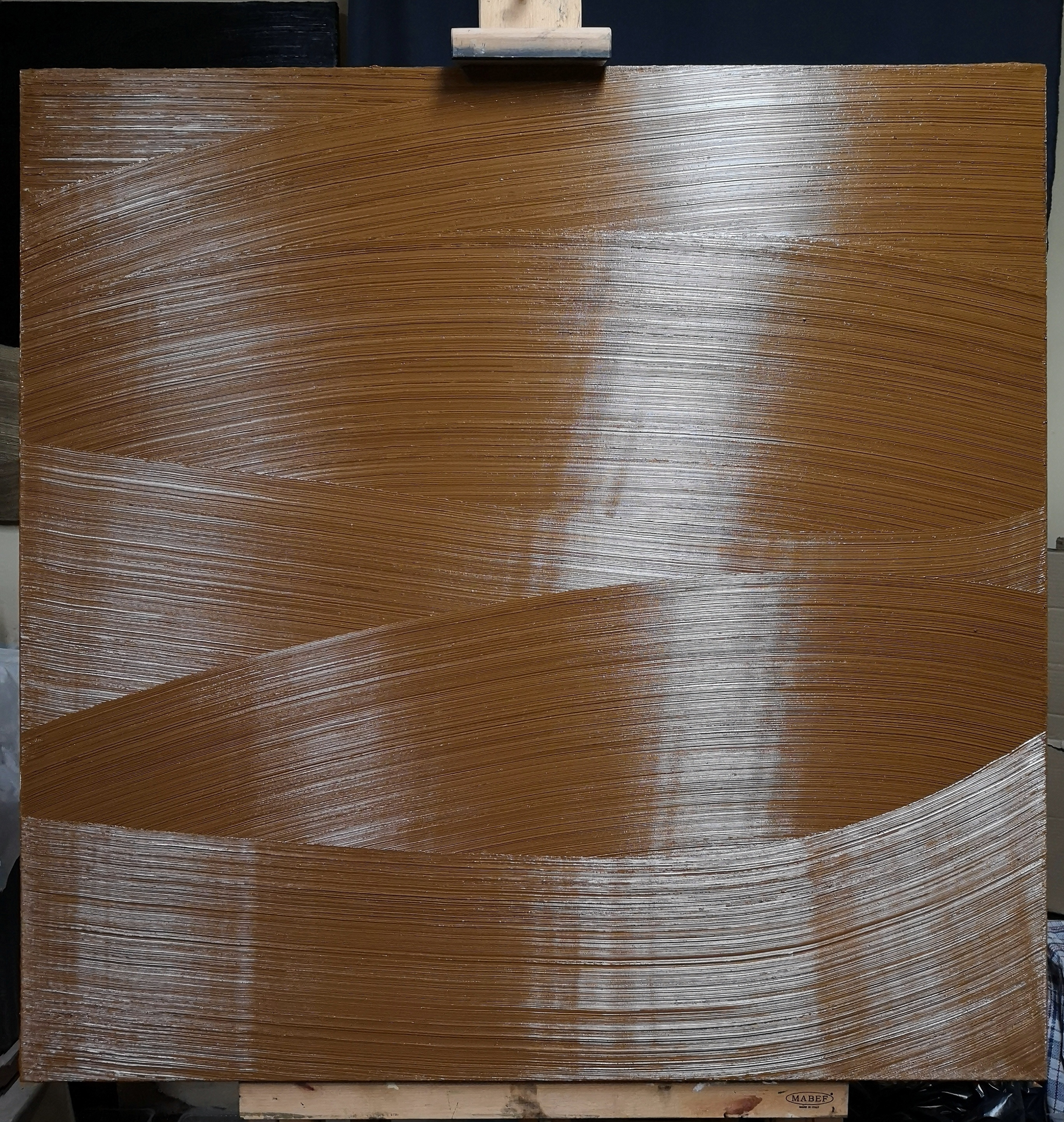
Вспоминая верного друга

Sweep of a broom in dust

Масло на холсте, 100×100 см


Взмах метлы в пыли,
на древней земле Сиены —
и все следы исчезают…


Oil on canvas, 100×100 cm

Sweep of a broom in dust,
on Siena’s ancient earth —
all traces vanish…

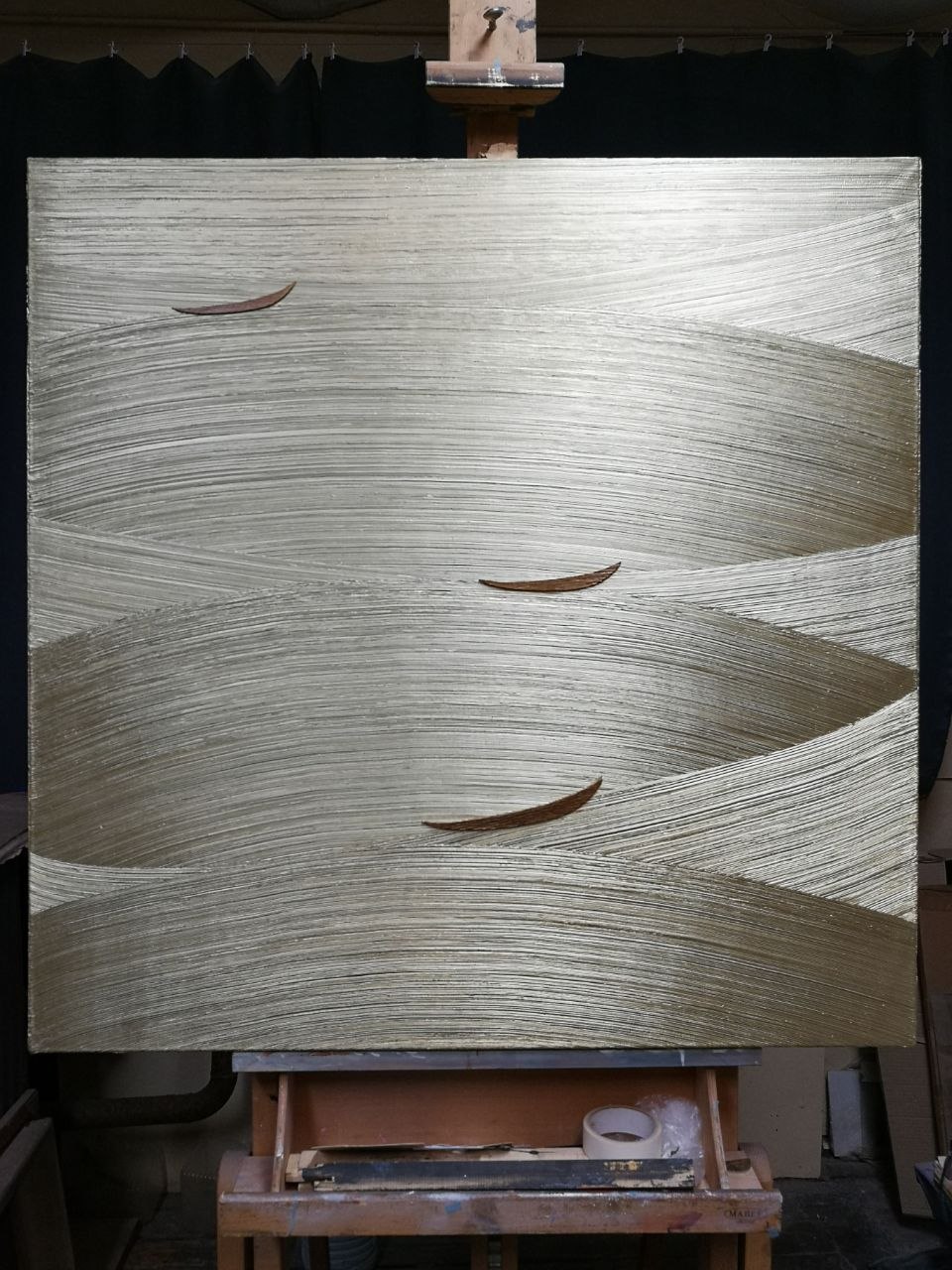
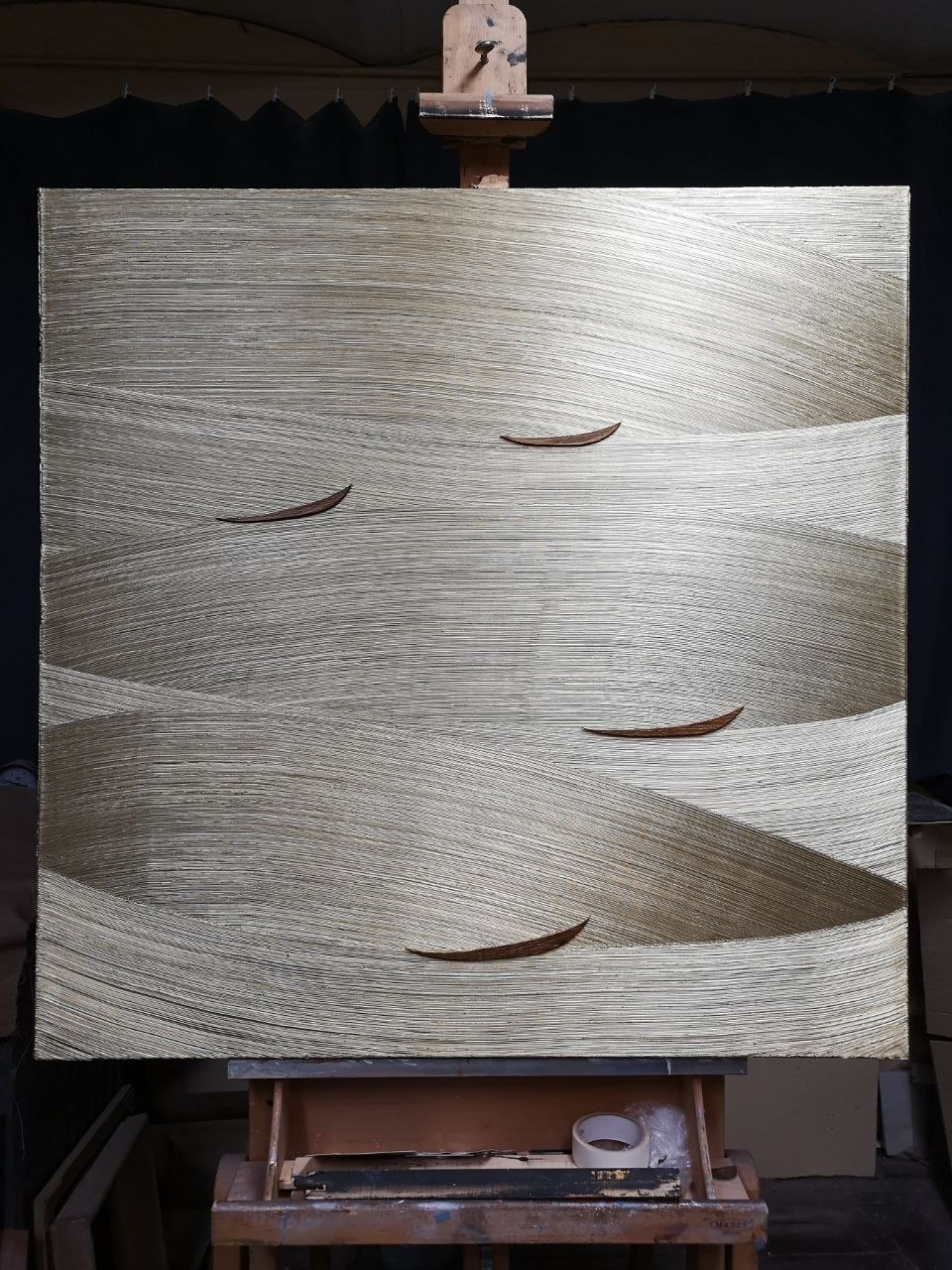
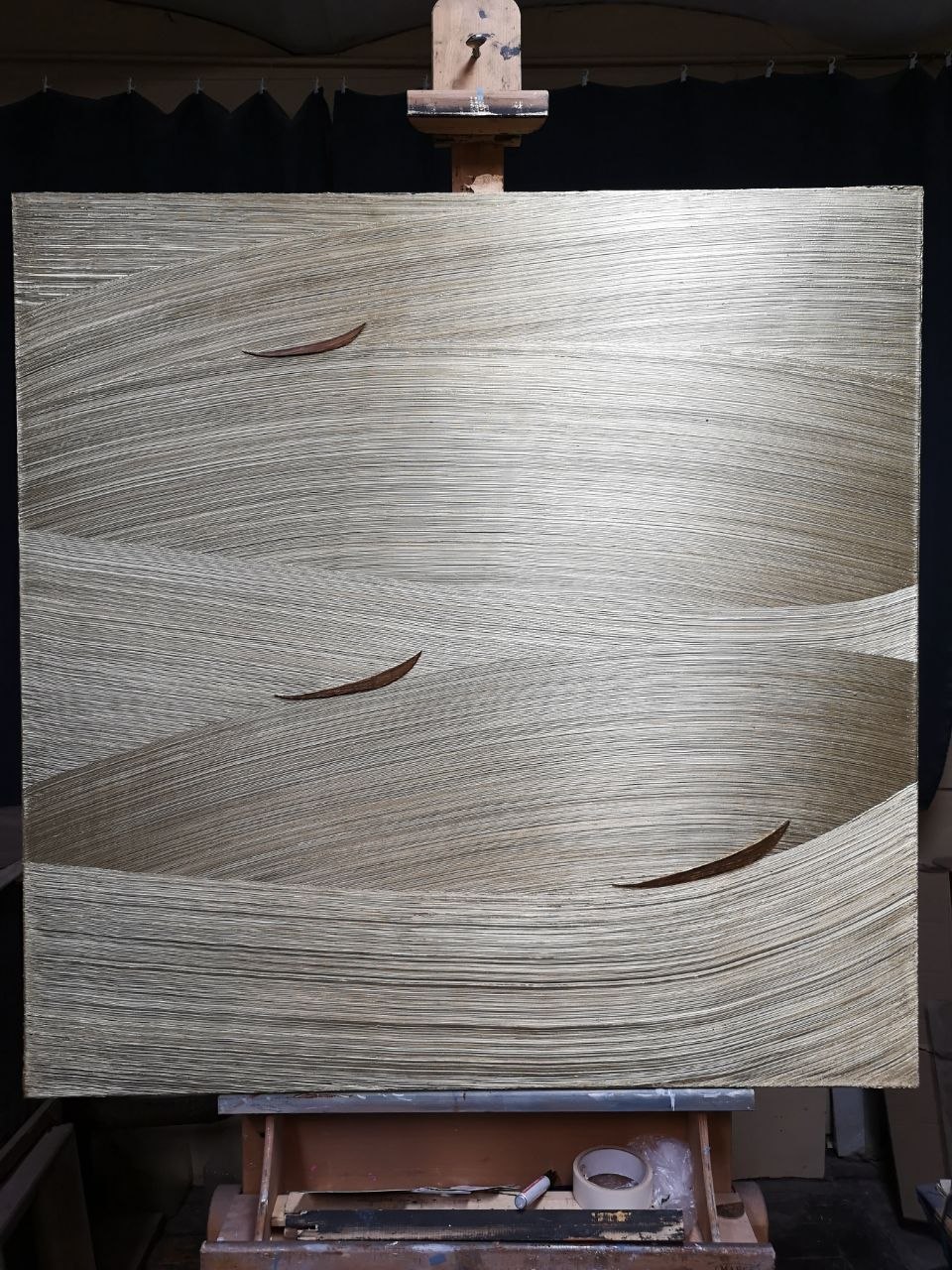
“Yellow Sea”

«Жёлтое море», холст, масло, 100 ×300 см

Холст разворачивается как пространство, где сам свет превращается в живую материю. Размашистые, волнообразные мазки создают мерцающую поверхность, вызывающую ассоциации с морем, наполненным солнечным светом. Здесь жёлтое и золотое — не декоративные элементы, а сама субстанция света, растянутая в бесконечность.

На фоне этого светоносного поля три чёрные линии — лодки — проявляются поразительно чётко. Они выглядят одновременно хрупкими и решительными, как тени, уплывающие вдаль. Эти лодки превращают абстрактное пространство в морской пейзаж: море обретает измерение, а свет приобретает человеческий масштаб.

Картина балансирует между абстракцией и фигуративностью. Здесь нет традиционного горизонта, но есть ощущение путешествия. Лодки словно подвешены в золотой зыби — в безграничности, где движение и неподвижность едины.

«Жёлтое море» звучит как медитация о человеческом присутствии в стихии: не противостояние, не слияние, но тонкое равновесие. Море и свет — не фон, а пространство, где лодка становится знаком пути, разворачивающегося сквозь сияние.


“Yellow Sea”, Oil on canvas, 300 cm

The canvas unfolds as a space where light itself turns into living matter. Sweeping, wave-like strokes create a shimmering surface that evokes the sea filled with sunlight. Here, yellow and gold are not decorative, but the very substance of light stretched into infinity.

Against this luminous field, three black lines — boats — become strikingly clear. They appear both fragile and resolute, like shadows drifting into the distance. These boats transform the abstract expanse into a seascape: the sea gains dimension, and the light acquires a human scale.

The painting balances between abstraction and figuration. There is no conventional horizon, yet there is the feeling of a journey. The boats seem suspended in the golden swell — in boundlessness, where movement and stillness are one.

Yellow Sea resonates as a meditation on human presence within the elements: not confrontation, not fusion, but a subtle equilibrium. The sea and the light are no backdrop, but a space where the boat becomes a sign of the path unfolding through radiance.

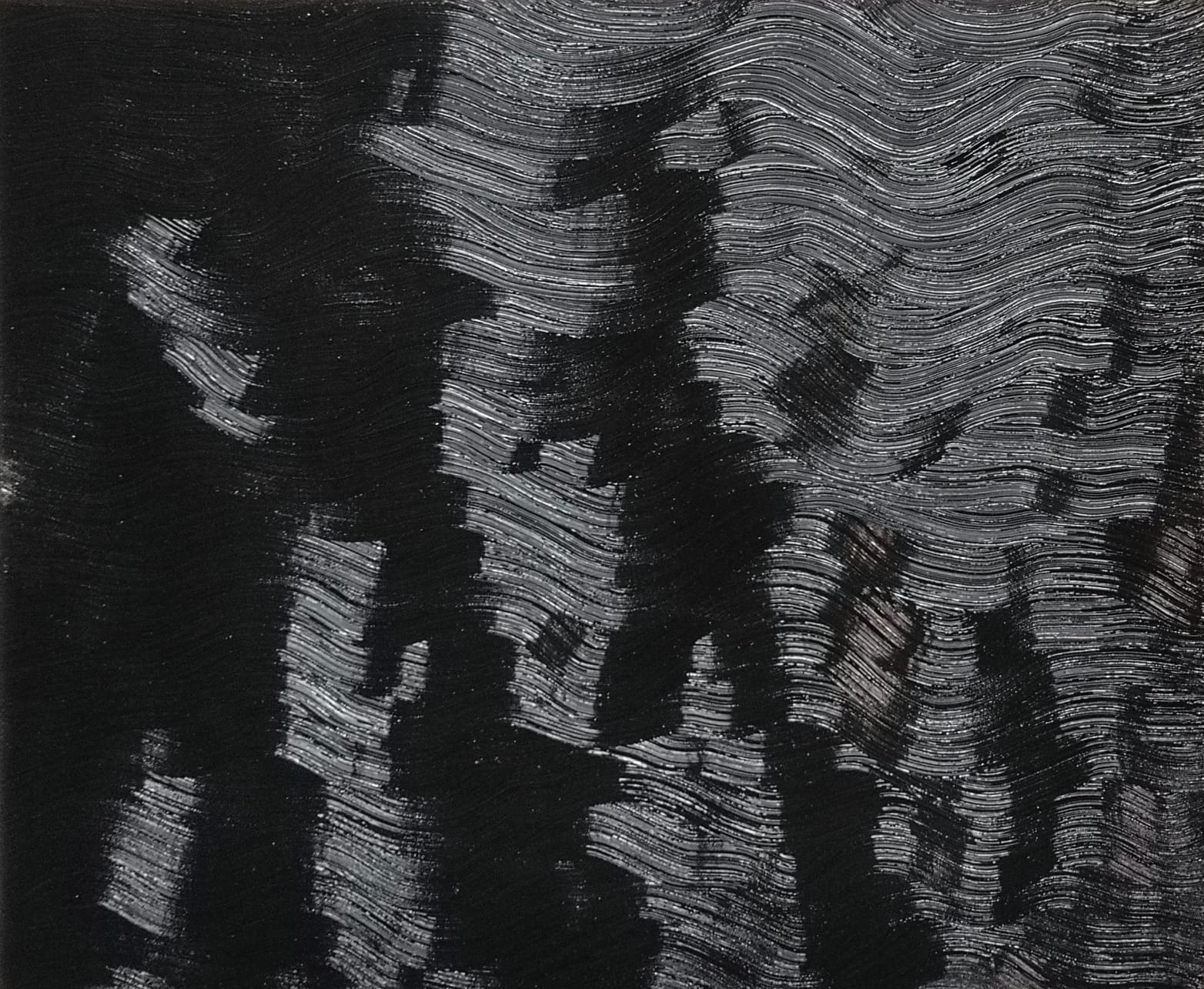
“Wave in Black”

Холст, масло, 70 x 90 см, сумма 140 x 180 см Волна в чёрном

Перед нами работа, которая кажется одновременно монохромной и бесконечно многоцветной. Чёрная краска — газовая сажа — положена плоско на холст, без малейшего намёка на рельеф. И всё же именно в этой плоскостности возникает оптическая глубина: линии и жесты кисти, наложенные друг на друга, образуют ткань, где свет играет, словно на воде или шёлке.

Масштаб произведения — 140 × 180 см — делает его почти стеной, мембраной, через которую зритель встречается с самим феноменом света. По мере изменения угла зрения поверхность оживает: нити отражают свет по-разному, превращая чёрное в пространство непрерывных колебаний.

Это живопись без цвета в обычном смысле, но полная целого спектра состояний. Здесь нет сюжета, нет образа, за который можно «зацепиться»; вместо этого зритель сталкивается с чистой энергией восприятия. Работа дышит как волна — то сжимаясь в темноту, то раскрываясь в сияние, напоминающее металл, стекло или мерцание ночного моря.

Эта чёрная оптика — одновременно эксперимент и медитация. Она выводит живопись за пределы традиционной роли носителя цвета и формы, превращая её в поле, где зрение движется, расщепляется, задерживается — и именно это напряжение между неподвижностью поверхности и её изменчивым сиянием порождает подлинный опыт.

В конечном счёте работа ощущается как медитация на природу света и тьмы: как чёрное становится светоносным, если смотреть достаточно долго; как простота оказывается сложнее иллюзии; как поверхность, лишённая глубины, внезапно открывает бездну.


Oil on canvas, 70 × 90 cm, summa 140 × 180 cm Wave in Black

Before us lies a work that appears at once monochrome and infinitely multicolored. Black paint — gas soot — has been laid flat on the canvas, without the slightest hint of relief. And yet, it is precisely within this flatness that optical depth emerges: lines and gestures of the brush, layered upon one another, form a fabric where light plays as if on water or silk.

The scale of the piece — 140 × 180 cm — makes it almost a wall, a membrane through which the viewer encounters the phenomenon of light itself. As the angle of vision shifts, the surface comes alive: the threads reflect light differently, transforming black into a space of continuous oscillations.

This is painting without color in the usual sense, yet full of a whole spectrum of states. There is no subject, no image to “hold on to”; instead, the viewer is confronted with the pure energy of perception. The work breathes like a wave — at times contracting into darkness, at times opening into a brilliance reminiscent of metal, glass, or the shimmer of a nocturnal sea.

This black optics is both an experiment and a meditation. It takes painting beyond the conventional role of carrying color and form, turning it into a field where vision travels, splits, lingers — and it is precisely this tension between the stillness of the surface and its shifting radiance that generates the true experience.

Ultimately, the work feels like a meditation on the nature of light and darkness: how black becomes luminous if one looks long enough; how simplicity proves more complex than illusion; how a surface devoid of depth suddenly reveals an abyss.

Biennale of Ecological Art, “The Skin of the Earth”, Nizhny Novgorod

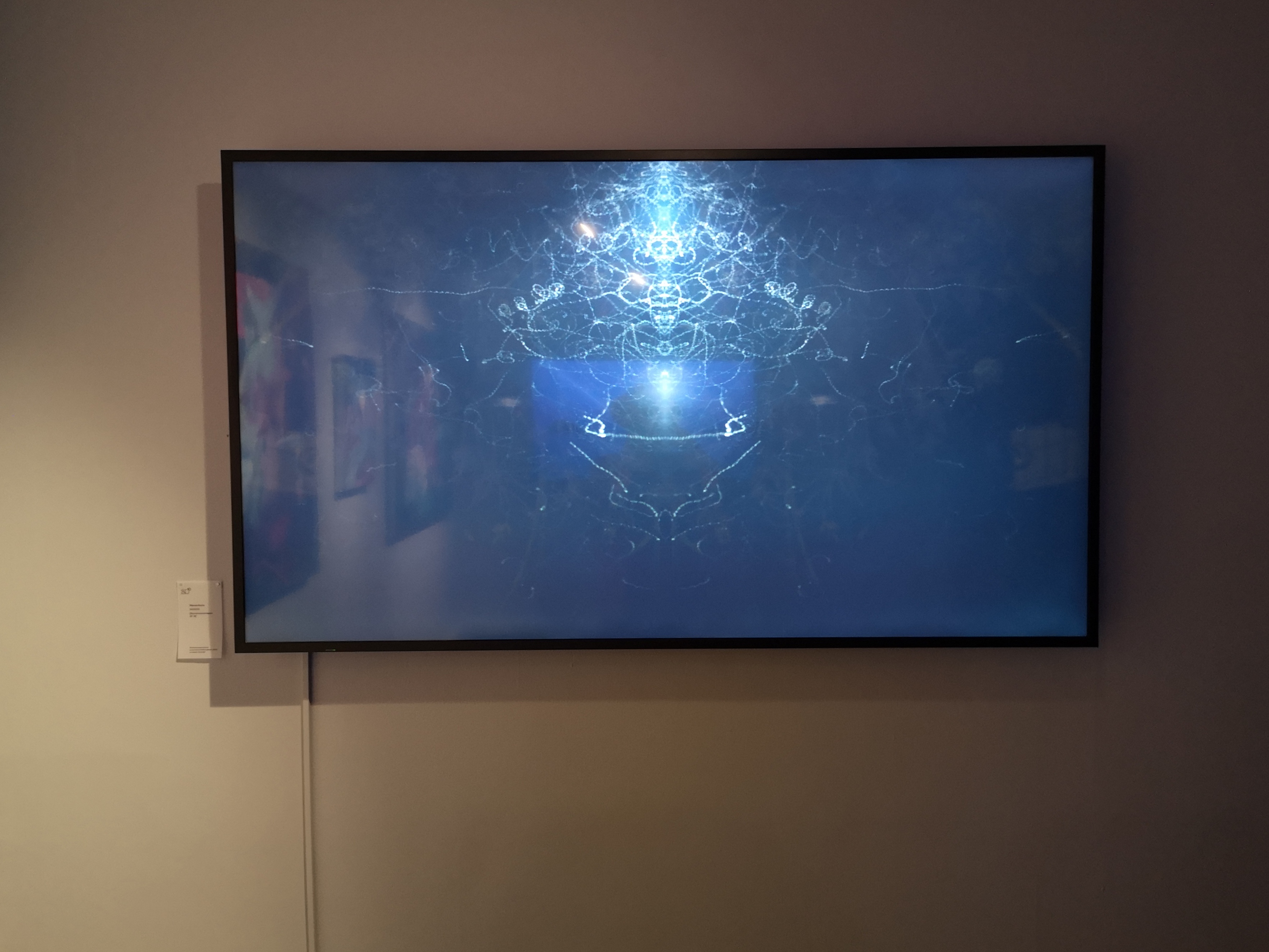
Максим Ксута, full HD видео-инсталляция

Этот проект — чистое художественное выражение в том смысле, что моё вмешательство в процесс было минимальным. В данном случае художник — как автор — лишь стал свидетелем странного и редкого природного явления: причудливого танца тысяч крошечных мотыльков в световом поле уличного фонаря.

Я установил камеру, чтобы запечатлеть сцену в течение определённого периода времени с определённым интервалом между кадрами. Результатом этой экспериментальной съёмки стало около 1200 фотографий, поразительно напоминающих необычные каллиграфические техники с элементами криптографии.

Чтобы отразить динамическую природу этого явления, я решил создать видео на основе этого материала, которое теперь представляю вашему вниманию.

Учёные уже давно пытаются понять, почему так много ночных мотыльков неудержимо тянет к свету. И по сей день нет окончательного ответа. Исследователи наблюдали, что чем ярче источник света, тем сильнее он привлекает насекомых.

Например, если в тёмной местности — скажем, в поле, на лесной поляне или в саду на даче — установить две лампочки: одну мощностью 250 ватт, а другую 1000 ватт, больше мотыльков соберётся вокруг более яркой, 1000-ваттной лампы. Интересно, что видовой состав мотыльков, похоже, не влияет на это поведение.

Но почему мотыльки начинают быстро кружиться вокруг горящей лампы, приближаясь к ней? Оказывается, что во время полёта эти насекомые ориентируются, удерживая источник света под постоянным углом — в частности, они пытаются поддерживать световой луч перпендикулярно оси своего тела. Поскольку искусственные источники света являются точечными, их лучи распространяются радиально. Когда мотыльки приближаются к такому свету, они пытаются держать себя перпендикулярно лучам, которые расположены по кругу — и мы, в свою очередь, очарованы их стремительным спиральным танцем вокруг светящихся фонарей.


Maxim Ksuta, Full HD Video Installation

This project is a pure artistic expression, in the sense that my intervention in the process was minimal. In this case, the artist—as the author—merely witnessed a strange and rare natural phenomenon: the bizarre dance of thousands of tiny moths within the light field of a streetlamp.

I set up the camera to capture the scene over a certain period of time with a specific interval between shots. The result of this experimental recording was around 1,200 photographs that strikingly resemble unusual calligraphic techniques, with elements of cryptography.

To reflect the dynamic nature of this phenomenon, I decided to create a video based on this footage, which I now present to your attention.

Scientists have long been trying to understand why so many nocturnal moths are irresistibly drawn to light. And to this day, there is no definitive answer. Researchers have observed that the brighter the light source, the more strongly it attracts insects.

For instance, if two lightbulbs are set up in a dark area—say, in a field, a forest clearing, or a garden at a summer cottage—one with 250 watts and the other with 1,000 watts, more moths will gather around the brighter, 1,000-watt bulb. Interestingly, the species composition of the moths doesn’t seem to influence this behavior.

But why do moths begin to circle rapidly around a lit lamp as they approach it? It turns out that during flight, these insects navigate by keeping a light source at a constant angle—specifically, they try to maintain the light beam perpendicular to the axis of their bodies. Since artificial lights are point sources, their rays spread out radially. As moths approach such a light, they attempt to keep themselves perpendicular to the rays, which are arranged in a circular pattern—and we, in turn, are captivated by their swift, spiraling dance around glowing lanterns.

The Modesty of Form as a Challenge to Dominant Taste

Скромность формы как вызов доминирующему вкусу Пьер Бурдьё

На первый взгляд эта фотография может показаться банальной: растение, пробивающееся сквозь асфальт у стены здания, два окна, обрезанные рамкой кадра, гладкая текстура штукатурки. Но, как это часто бывает в полях культурного производства, сама банальность становится формой сопротивления.

Мы должны задать центральный вопрос: почему подобное изображение заслуживает эстетического признания? Кто обладает властью приписывать смысл чему-то столь «незначительному»? Это не просто фотография растения — это манифест вкуса, отвергающий предпочтения доминирующих классов, для которых «красота» состоит из тосканских пейзажей, обнажённых тел или архитектуры, достойной Architectural Digest.

Это изображение отказывается участвовать в зрелище. Оно представляет то, что нейтрализовано повседневной жизнью, что лишено признанного статуса. И тем самым оно совершает жест — жест рефлексивной эстетики, эстетики дистанцированной, почти аскетичной. Оно позиционирует себя в пространстве «высокой культуры», но делает это, инвертируя её коды — показывая незначительное, фокусируясь на деталях, которые элита обучена игнорировать.

Посмотрите на две оконные рамы, зеркально отражённые в своём удалении от центра, но смещённые к верхней части. Их симметрия асимметрична. Это сама структура социального пространства: оно кажется логичным, но в действительности представляет собой поле борьбы. Точно так же и здесь — эстетическая симметрия нарушена, поскольку баланс между культурным капиталом и доступом к нему всегда неравен.

Но есть более тонкий момент. Растение, пробивающееся сквозь трещину, — это метафора габитуса, воплощённого носителя структуры. Оно растёт не где попало, а там, где позволяют условия. Оно не выбирает свободу — оно действует в пределах возможного. И всё же оно существует. Его форма — это форма вынужденной адаптации.

Возможно, фотограф не имел в виду подобную социальную деконструкцию, но в поле искусства намерение не всегда ключевое. Важна позиция работы в структуре поля. И здесь, в этой фотографии, я вижу работу, которая отвергает орнаментальность, отказывается демонстрировать технику и вместо этого возводит обыденное на уровень достойного.

Именно такая фотография бросает вызов не только академическому вкусу, но и всей системе его производства и легитимации.

#Fujica6x9 #ПосмертныйВзгляд


The Modesty of Form as a Challenge to Dominant Taste By Pierre Bourdieu

At first glance, this photograph may seem banal: a plant pushing through the asphalt by a building wall, two windows cut off by the frame, the smooth texture of the plaster. But, as is often the case within the fields of cultural production, banality itself becomes a form of resistance.

We must ask the central question: why does such an image deserve aesthetic recognition? Who has the authority to assign meaning to something so “insignificant”? This is not merely a photograph of a plant — it is a manifesto of taste, rejecting the preferences of the dominant classes, for whom “beauty” consists of Tuscan landscapes, nude bodies, or architecture worthy of Architectural Digest.

This image refuses to participate in the spectacle. It presents what has been neutralized by everyday life, what lacks recognized status. And in doing so, it performs a gesture — a gesture of reflexive aesthetics, an aesthetics that is distanced, almost ascetic. It positions itself within the space of “high culture,” but does so by inverting its codes — by showing the insignificant, by focusing on details the elite are trained to ignore.

Look at the two window frames, mirrored in their distance from the center but offset toward the top. Their symmetry is asymmetrical. This is the very structure of social space: it appears logical, but in reality, it is a field of struggle. Just like here — aesthetic symmetry is disrupted, as the balance between cultural capital and access to it is always unequal.

But there is a more subtle point. The plant pushing through the crack is a metaphor for habitus, the embodied carrier of structure. It does not grow just anywhere, but where conditions permit. It does not choose freedom — it acts within the realm of the possible. And yet it exists. Its form is the form of forced adaptation.

Perhaps the photographer did not intend this kind of social deconstruction, but in the field of art, intention is not always key. What matters is the work’s position within the structure of the field. And here, in this photograph, I see a work that rejects ornamentation, refuses to display technique, and instead elevates the ordinary to the level of the worthy.

It is precisely this kind of photograph that challenges not only academic taste but the entire system of its production and legitimation.

#Fujica6x9 #PosthumousGaze

Ragas Of Morning & Night

About the Artist: Pandit Pran Nath

Pandit Pran Nath was one of the last great masters of the Kirana gharana, a North Indian vocal tradition rooted in deep spirituality and microtonal precision.
Born in 1918 in India, he was a disciple of the legendary Abdul Wahid Khan.
In the 1970s, he became a guru and spiritual teacher to Western minimalist composers such as La Monte Young, Terry Riley, and Marian Zazeela.
His music is not a performance in the Western sense — it is sādhanā, a spiritual practice of sound as a path to transcendence.


🎶 About the Album: Ragas of Morning and Night

(Released in 1986 on Gramavision Records)

This album features two traditional ragas, ancient Indian musical forms designed to evoke specific moods and states of consciousness, each associated with a particular time of day.

1. Raga Todi (Morning Raga)

  • Performed at sunrise.
  • Mood: introspective, delicate, meditative.
  • It reflects the awakening of nature, the unfolding of light.
  • The vocal line slowly develops over a drone, dwelling in microtones — it feels as if each note trembles gently like a petal in the mist.

2. Raga Darbari (Night Raga)

  • Meant to be performed at night.
  • Mood: deep, mysterious, hypnotic.
  • Darbari is one of the most majestic and emotionally intense ragas in Indian music.
  • Pran Nath’s voice resonates like a mantra — not with words, but with pure emotional truth through sound.

🔊 The Sound

  • No melodic instruments are used, only tanpura (drone) and tabla (rhythm).
  • The development is very slow and contemplative, nearly a form of sonic meditation.
  • There’s no linear melody — instead, it explores the depth of a single tone, a single vibration.

🌀 Influence on Western Music

This album — and Pandit Pran Nath himself — had a profound impact on American minimalist music.
Artists like La Monte Young, Terry Riley, Jon Hassell, and even Brian Eno either studied with him or drew inspiration from his approach to extended duration and microtonality.
These ragas are more than music — they’re a transmission of inner states and meditative stillness through the human voice.

Quantum Project

Представленная работа является частью серии «Квантовый проект», которая сочетает скрупулезную технику художника и концептуальную глубину. Картина, созданная полностью кистью № 2, черпает вдохновение в изысканной красоте римских микромозаик. Каждый мазок кисти становится фрагментом большего целого, формируя целостное изображение с тактильной, мозаикоподобной текстурой.

Художник тщательно разработал индивидуальную палитру, основанную на принципах индексированного цвета. Этот подход позволяет произведению достичь гармоничного баланса оттенков и систематической структуры, напоминающей цифровую пикселизацию, но при этом сохраняющей органическую суть традиционной живописи. Продуманный выбор и нанесение цвета превращают каждый элемент в символ точности, предполагая взаимосвязь микро- и макромира.

«Квантовая живопись» как техника соединяет миры науки и искусства. Название «Квантовый проект» воплощает концептуальную основу этой серии. Каждая картина отражает сложность квантовых процессов, где порядок и хаос сосуществуют, а мельчайшие частицы формируют ткань вселенной. Этот инновационный подход побуждает зрителей вникнуть в соотношение между структурой, случайностью и восприятием.

Серия приглашает к созерцанию времени и пространства, предлагая медитативный опыт, сродни наблюдению бесконечных деталей в природе или космосе. Это прославление сложного и монументального, достигнутого через мельчайшие жесты кисти, откликающееся вечным традициям древнего мозаичного мастерства, одновременно раздвигая границы современного искусства.


The presented artwork is part of the series “Quantum Project,” which combines the artist’s meticulous technique and conceptual depth. The painting, created entirely with a No. 2 brush, draws inspiration from the intricate beauty of Roman micro-mosaics. Each brushstroke becomes a fragment of a greater whole, forming a cohesive image with a tactile, mosaic-like texture.

The artist has meticulously developed a custom palette based on the principles of indexed color. This approach allows the artwork to achieve a harmonious balance of hues and a systematic structure, reminiscent of digital pixelation yet maintaining the organic essence of traditional painting. The deliberate selection and application of color transform each element into a symbol of precision, suggesting the interconnectivity of the micro and macro.

“Quantum Painting,” as a technique, bridges the worlds of science and art. The title “Quantum Project” encapsulates the conceptual underpinning of this series. Each painting reflects the complexity of quantum processes, where order and chaos coexist, and the smallest particles form the fabric of the universe. This innovative approach encourages viewers to delve into the relationship between structure, randomness, and perception.

The series invites contemplation of time and space, offering a meditative experience akin to observing the infinite detail in nature or the cosmos. It is a celebration of the intricate and the monumental, achieved through the smallest gestures of the brush, echoing the timeless traditions of ancient mosaic craftsmanship while pushing the boundaries of contemporary art.

New group exhibition – “Horizon – The Color Blue”

Photo – Elena Rubinina