Maxim Ksuta

russian artist, contemporary art, sculpture, installation, photography

Month: May, 2025

Biennale of Ecological Art, “The Skin of the Earth”, Nizhny Novgorod

Максим Ксута, full HD видео-инсталляция

Этот проект — чистое художественное выражение в том смысле, что моё вмешательство в процесс было минимальным. В данном случае художник — как автор — лишь стал свидетелем странного и редкого природного явления: причудливого танца тысяч крошечных мотыльков в световом поле уличного фонаря.

Я установил камеру, чтобы запечатлеть сцену в течение определённого периода времени с определённым интервалом между кадрами. Результатом этой экспериментальной съёмки стало около 1200 фотографий, поразительно напоминающих необычные каллиграфические техники с элементами криптографии.

Чтобы отразить динамическую природу этого явления, я решил создать видео на основе этого материала, которое теперь представляю вашему вниманию.

Учёные уже давно пытаются понять, почему так много ночных мотыльков неудержимо тянет к свету. И по сей день нет окончательного ответа. Исследователи наблюдали, что чем ярче источник света, тем сильнее он привлекает насекомых.

Например, если в тёмной местности — скажем, в поле, на лесной поляне или в саду на даче — установить две лампочки: одну мощностью 250 ватт, а другую 1000 ватт, больше мотыльков соберётся вокруг более яркой, 1000-ваттной лампы. Интересно, что видовой состав мотыльков, похоже, не влияет на это поведение.

Но почему мотыльки начинают быстро кружиться вокруг горящей лампы, приближаясь к ней? Оказывается, что во время полёта эти насекомые ориентируются, удерживая источник света под постоянным углом — в частности, они пытаются поддерживать световой луч перпендикулярно оси своего тела. Поскольку искусственные источники света являются точечными, их лучи распространяются радиально. Когда мотыльки приближаются к такому свету, они пытаются держать себя перпендикулярно лучам, которые расположены по кругу — и мы, в свою очередь, очарованы их стремительным спиральным танцем вокруг светящихся фонарей.


Maxim Ksuta, Full HD Video Installation

This project is a pure artistic expression, in the sense that my intervention in the process was minimal. In this case, the artist—as the author—merely witnessed a strange and rare natural phenomenon: the bizarre dance of thousands of tiny moths within the light field of a streetlamp.

I set up the camera to capture the scene over a certain period of time with a specific interval between shots. The result of this experimental recording was around 1,200 photographs that strikingly resemble unusual calligraphic techniques, with elements of cryptography.

To reflect the dynamic nature of this phenomenon, I decided to create a video based on this footage, which I now present to your attention.

Scientists have long been trying to understand why so many nocturnal moths are irresistibly drawn to light. And to this day, there is no definitive answer. Researchers have observed that the brighter the light source, the more strongly it attracts insects.

For instance, if two lightbulbs are set up in a dark area—say, in a field, a forest clearing, or a garden at a summer cottage—one with 250 watts and the other with 1,000 watts, more moths will gather around the brighter, 1,000-watt bulb. Interestingly, the species composition of the moths doesn’t seem to influence this behavior.

But why do moths begin to circle rapidly around a lit lamp as they approach it? It turns out that during flight, these insects navigate by keeping a light source at a constant angle—specifically, they try to maintain the light beam perpendicular to the axis of their bodies. Since artificial lights are point sources, their rays spread out radially. As moths approach such a light, they attempt to keep themselves perpendicular to the rays, which are arranged in a circular pattern—and we, in turn, are captivated by their swift, spiraling dance around glowing lanterns.
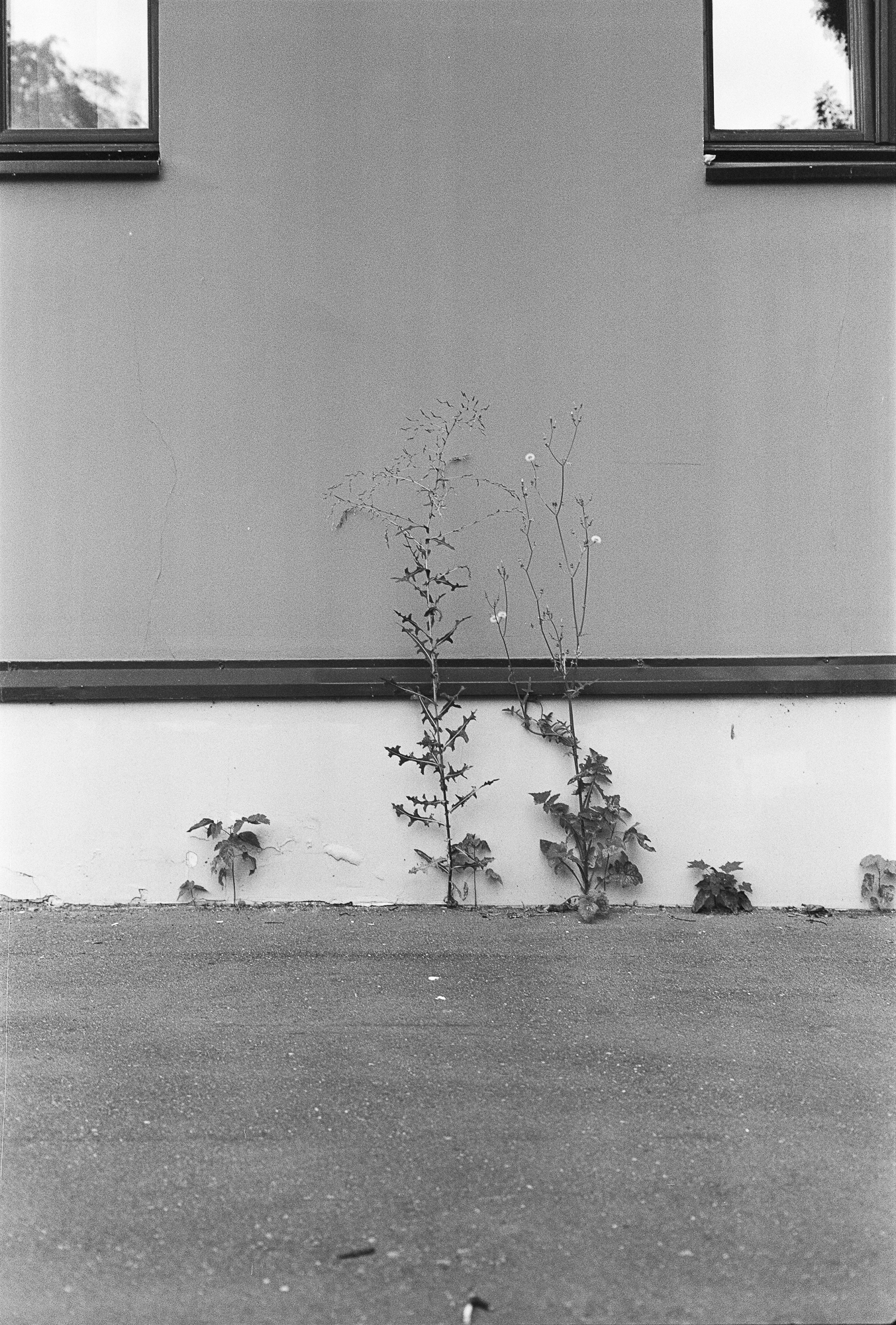
The Modesty of Form as a Challenge to Dominant Taste

Скромность формы как вызов доминирующему вкусу Пьер Бурдьё

На первый взгляд эта фотография может показаться банальной: растение, пробивающееся сквозь асфальт у стены здания, два окна, обрезанные рамкой кадра, гладкая текстура штукатурки. Но, как это часто бывает в полях культурного производства, сама банальность становится формой сопротивления.

Мы должны задать центральный вопрос: почему подобное изображение заслуживает эстетического признания? Кто обладает властью приписывать смысл чему-то столь «незначительному»? Это не просто фотография растения — это манифест вкуса, отвергающий предпочтения доминирующих классов, для которых «красота» состоит из тосканских пейзажей, обнажённых тел или архитектуры, достойной Architectural Digest.

Это изображение отказывается участвовать в зрелище. Оно представляет то, что нейтрализовано повседневной жизнью, что лишено признанного статуса. И тем самым оно совершает жест — жест рефлексивной эстетики, эстетики дистанцированной, почти аскетичной. Оно позиционирует себя в пространстве «высокой культуры», но делает это, инвертируя её коды — показывая незначительное, фокусируясь на деталях, которые элита обучена игнорировать.

Посмотрите на две оконные рамы, зеркально отражённые в своём удалении от центра, но смещённые к верхней части. Их симметрия асимметрична. Это сама структура социального пространства: оно кажется логичным, но в действительности представляет собой поле борьбы. Точно так же и здесь — эстетическая симметрия нарушена, поскольку баланс между культурным капиталом и доступом к нему всегда неравен.

Но есть более тонкий момент. Растение, пробивающееся сквозь трещину, — это метафора габитуса, воплощённого носителя структуры. Оно растёт не где попало, а там, где позволяют условия. Оно не выбирает свободу — оно действует в пределах возможного. И всё же оно существует. Его форма — это форма вынужденной адаптации.

Возможно, фотограф не имел в виду подобную социальную деконструкцию, но в поле искусства намерение не всегда ключевое. Важна позиция работы в структуре поля. И здесь, в этой фотографии, я вижу работу, которая отвергает орнаментальность, отказывается демонстрировать технику и вместо этого возводит обыденное на уровень достойного.

Именно такая фотография бросает вызов не только академическому вкусу, но и всей системе его производства и легитимации.

#Fujica6x9 #ПосмертныйВзгляд


The Modesty of Form as a Challenge to Dominant Taste By Pierre Bourdieu

At first glance, this photograph may seem banal: a plant pushing through the asphalt by a building wall, two windows cut off by the frame, the smooth texture of the plaster. But, as is often the case within the fields of cultural production, banality itself becomes a form of resistance.

We must ask the central question: why does such an image deserve aesthetic recognition? Who has the authority to assign meaning to something so “insignificant”? This is not merely a photograph of a plant — it is a manifesto of taste, rejecting the preferences of the dominant classes, for whom “beauty” consists of Tuscan landscapes, nude bodies, or architecture worthy of Architectural Digest.

This image refuses to participate in the spectacle. It presents what has been neutralized by everyday life, what lacks recognized status. And in doing so, it performs a gesture — a gesture of reflexive aesthetics, an aesthetics that is distanced, almost ascetic. It positions itself within the space of “high culture,” but does so by inverting its codes — by showing the insignificant, by focusing on details the elite are trained to ignore.

Look at the two window frames, mirrored in their distance from the center but offset toward the top. Their symmetry is asymmetrical. This is the very structure of social space: it appears logical, but in reality, it is a field of struggle. Just like here — aesthetic symmetry is disrupted, as the balance between cultural capital and access to it is always unequal.

But there is a more subtle point. The plant pushing through the crack is a metaphor for habitus, the embodied carrier of structure. It does not grow just anywhere, but where conditions permit. It does not choose freedom — it acts within the realm of the possible. And yet it exists. Its form is the form of forced adaptation.

Perhaps the photographer did not intend this kind of social deconstruction, but in the field of art, intention is not always key. What matters is the work’s position within the structure of the field. And here, in this photograph, I see a work that rejects ornamentation, refuses to display technique, and instead elevates the ordinary to the level of the worthy.

It is precisely this kind of photograph that challenges not only academic taste but the entire system of its production and legitimation.

#Fujica6x9 #PosthumousGaze

Ragas Of Morning & Night

About the Artist: Pandit Pran Nath

Pandit Pran Nath was one of the last great masters of the Kirana gharana, a North Indian vocal tradition rooted in deep spirituality and microtonal precision.
Born in 1918 in India, he was a disciple of the legendary Abdul Wahid Khan.
In the 1970s, he became a guru and spiritual teacher to Western minimalist composers such as La Monte Young, Terry Riley, and Marian Zazeela.
His music is not a performance in the Western sense — it is sādhanā, a spiritual practice of sound as a path to transcendence.


🎶 About the Album: Ragas of Morning and Night

(Released in 1986 on Gramavision Records)

This album features two traditional ragas, ancient Indian musical forms designed to evoke specific moods and states of consciousness, each associated with a particular time of day.

1. Raga Todi (Morning Raga)

  • Performed at sunrise.
  • Mood: introspective, delicate, meditative.
  • It reflects the awakening of nature, the unfolding of light.
  • The vocal line slowly develops over a drone, dwelling in microtones — it feels as if each note trembles gently like a petal in the mist.

2. Raga Darbari (Night Raga)

  • Meant to be performed at night.
  • Mood: deep, mysterious, hypnotic.
  • Darbari is one of the most majestic and emotionally intense ragas in Indian music.
  • Pran Nath’s voice resonates like a mantra — not with words, but with pure emotional truth through sound.

🔊 The Sound

  • No melodic instruments are used, only tanpura (drone) and tabla (rhythm).
  • The development is very slow and contemplative, nearly a form of sonic meditation.
  • There’s no linear melody — instead, it explores the depth of a single tone, a single vibration.

🌀 Influence on Western Music

This album — and Pandit Pran Nath himself — had a profound impact on American minimalist music.
Artists like La Monte Young, Terry Riley, Jon Hassell, and even Brian Eno either studied with him or drew inspiration from his approach to extended duration and microtonality.
These ragas are more than music — they’re a transmission of inner states and meditative stillness through the human voice.