The Photographic Poetics of Fragmentation
Essay by Clive Scott:
“The Photographic Poetics of Fragmentation”
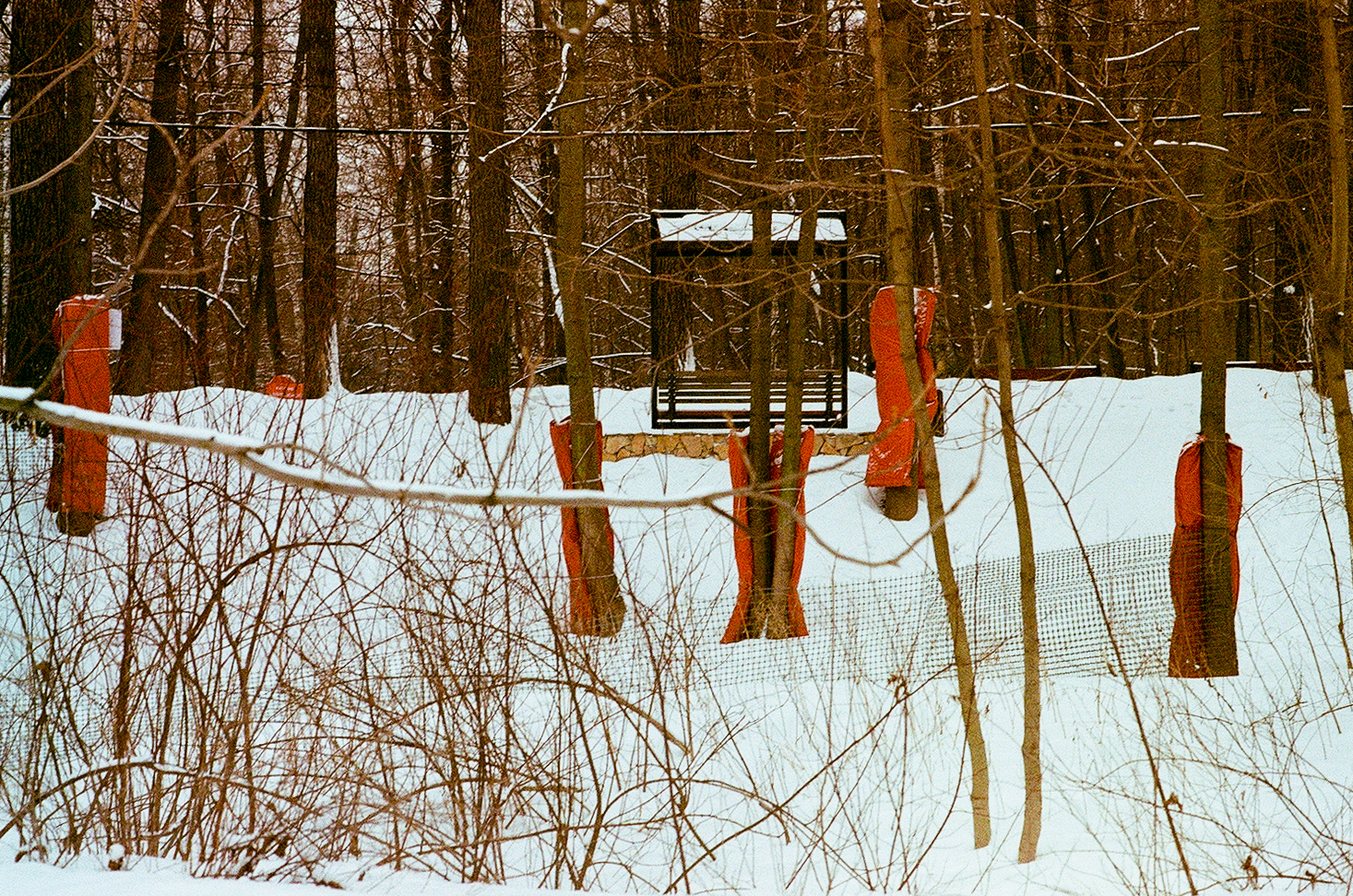
This photograph operates not only through its imagery but through perception itself, compelling us to see through its language—a language of disjointedness, fragmentation, and texture. A distinct approach to framing is at work here: rather than offering the viewer a complete picture, it invites us to see the world as a collection of visual elements, each carrying an underlying tension.
In the foreground, a tangle of branches forms a natural chaos, partially obscuring the scene and leaving it on the verge of revelation. Beyond this layer, a differently structured space emerges: the strict verticals of trees stand like columns, supporting the rhythm of the composition. Their trunks are wrapped in red protective coverings—a striking visual accent that disrupts the monochromatic harmony of the winter forest. The red here is a gesture, a statement—perhaps one of protection, yet it may also be read as a sign of intrusion, alteration, or violence.
The photograph explores the boundary between the visible and the hidden. What lies beyond these trees? What role does this scene play in the space of the real world? The presence of a grid on the snow and a wooden pavilion suggests a place of human intervention—but in what context? We do not know, and the image offers no answers, only deepening our engagement in the act of interpretation.
Here, photography reveals its essence as a fragmentary art form: it extracts a piece of reality but does not enclose it within itself. Instead, it offers it as the starting point for an infinite narrative. This work exists not only in its visual plane but also in the viewer’s consciousness, where, following the pathways of its composition, one fills in the gaps with personal assumptions and sensations.
This is not just an image—it is an act of visual thinking. It speaks in the language of signs, suggestions, and omissions, and therein lies its poetic power.
#NikonFM2
#PosthumousGaze
 Maxim Ksuta