Maxim Ksuta

russian artist, contemporary art, sculpture, installation, photography

Tag: NikonFM2

The Photographic Poetics of Fragmentation
Essay by Clive Scott:

“The Photographic Poetics of Fragmentation”

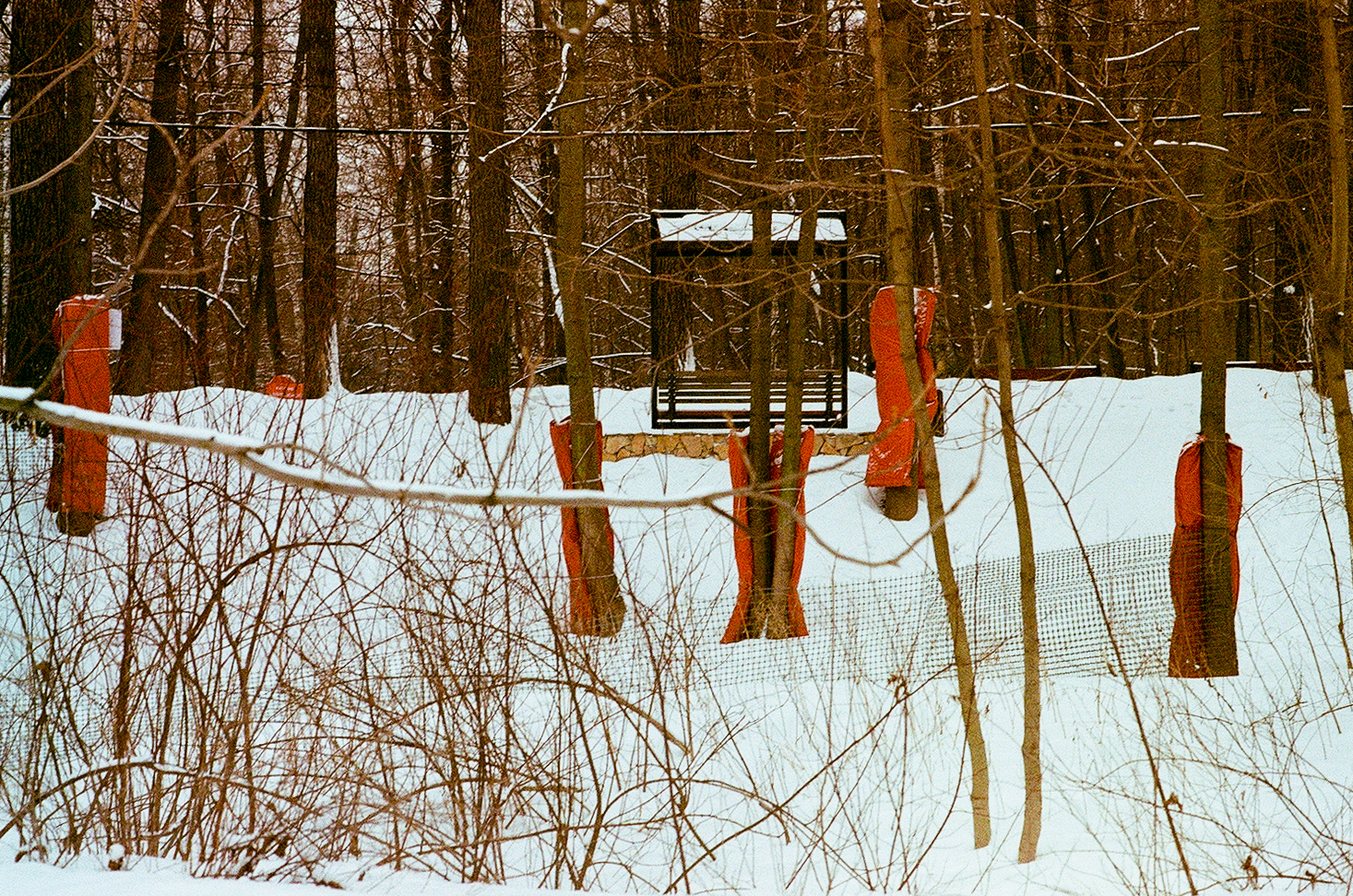
This photograph operates not only through its imagery but through perception itself, compelling us to see through its language—a language of disjointedness, fragmentation, and texture. A distinct approach to framing is at work here: rather than offering the viewer a complete picture, it invites us to see the world as a collection of visual elements, each carrying an underlying tension.

In the foreground, a tangle of branches forms a natural chaos, partially obscuring the scene and leaving it on the verge of revelation. Beyond this layer, a differently structured space emerges: the strict verticals of trees stand like columns, supporting the rhythm of the composition. Their trunks are wrapped in red protective coverings—a striking visual accent that disrupts the monochromatic harmony of the winter forest. The red here is a gesture, a statement—perhaps one of protection, yet it may also be read as a sign of intrusion, alteration, or violence.

The photograph explores the boundary between the visible and the hidden. What lies beyond these trees? What role does this scene play in the space of the real world? The presence of a grid on the snow and a wooden pavilion suggests a place of human intervention—but in what context? We do not know, and the image offers no answers, only deepening our engagement in the act of interpretation.

Here, photography reveals its essence as a fragmentary art form: it extracts a piece of reality but does not enclose it within itself. Instead, it offers it as the starting point for an infinite narrative. This work exists not only in its visual plane but also in the viewer’s consciousness, where, following the pathways of its composition, one fills in the gaps with personal assumptions and sensations.

This is not just an image—it is an act of visual thinking. It speaks in the language of signs, suggestions, and omissions, and therein lies its poetic power.

#NikonFM2
#PosthumousGaze
Photography as a Witness to Time and Space (in the Spirit of John Szarkowski)

Photography as a Witness to Time and Space (in the Spirit of John Szarkowski)

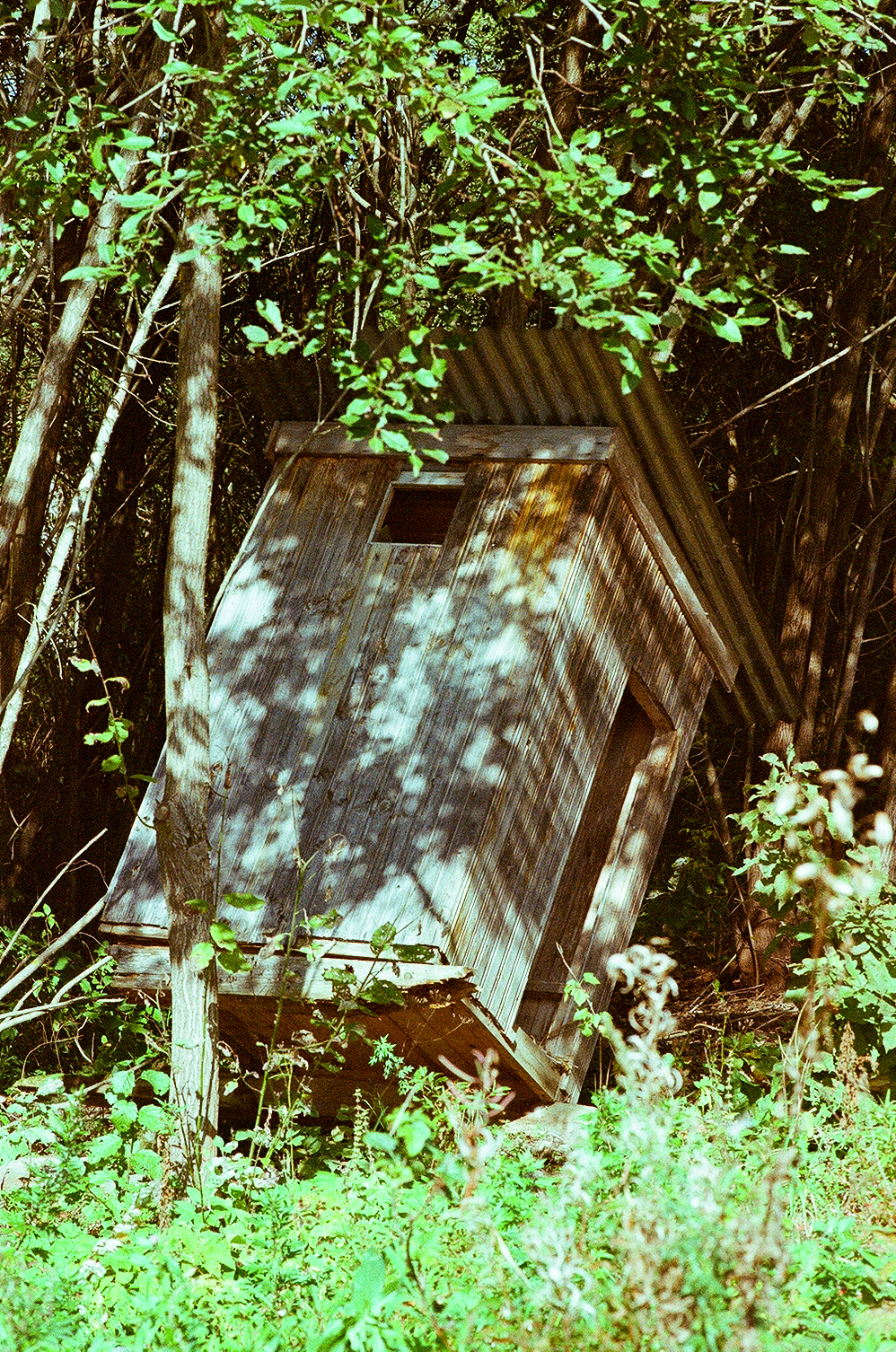
Photography has always been not just a means of capturing reality but also a way of revealing the invisible structures within the ordinary. This image is proof of that. At first glance, we see nothing more than an abandoned rural outhouse, leaning and engulfed by the green chaos of vegetation. Yet the photographer’s gaze transforms it into something more: a symbol, a story, a testament to time.

I have always believed that one of photography’s most essential functions is not merely to document but to interpret. Here, composition plays with the tension between the man-made object and the nature reclaiming it. The vertical lines of the trees engage in a dialogue with the slanted geometry of the wooden structure, creating a sense of movement—as if nature is gradually reclaiming what was once part of human daily life.

This object, once serving a utilitarian purpose, has now been discarded beyond the boundaries of the homestead, standing at the threshold between civilization and wilderness. There is a strange poetry in this: an object that was once an essential part of everyday life has become obsolete, stripped of its function, awaiting its final dissolution into the surrounding landscape.

Photography captures the moment of this transformation, simultaneously reminding us of the impermanence of all things and their inevitable return to primordial chaos. This image brings to mind the works of William Eggleston and his ability to uncover beauty and meaning in the most unexpected, even banal, subjects. In the end, a great photograph does not merely show—it allows us to see.

#NikonFM2
#PosthumousGaze

An Essay from the Perspective of Alain Badiou

Essay by Alain Badiou: “Form, Event, Truth”

This photograph does not ask us what we see but rather how seeing itself is structured. Here, at the center of an open landscape, stands an empty frame—devoid of its own content, yet transformed into a site for truth. It is not merely a frame but an event, one that organizes space and compels us to question its naturalness.

In the tradition of Platonic philosophy, truth is never given to us directly—it requires construction, mediation. This frame is a structure that marks an absence, yet through this very absence, it reveals the process of distinction itself: what is inside, and what is outside? Does the field within the frame differ from what surrounds it? No, and yet we begin to see it differently.

This is how an event is born—a sudden rupture in the order of the visible. We find ourselves in a situation where the artificial creates the conditions for a new perception of the real. The field, which has always been a field, is now transformed into a sign. The boundary between landscape and its representation becomes unstable, and we find ourselves inside this duality, unable to determine where exactly the line between art and the world is drawn.

What matters here is not only what is depicted but also the very act of framing. This is not a gesture of authority, not an ordering of chaos, but rather a challenge—an invitation for the viewer to recognize that all vision is a choice, that truth is never given to us directly but always emerges through rupture, through an event that reorganizes our structures of perception.

In this sense, photography does not merely document reality; it plays with it, revealing what would otherwise remain unnoticed in everyday life. It becomes an act of thought and, therefore, a space for truth.

#NikonFM2
#PosthumousGaze