by maxksuta
Супрематические сороки
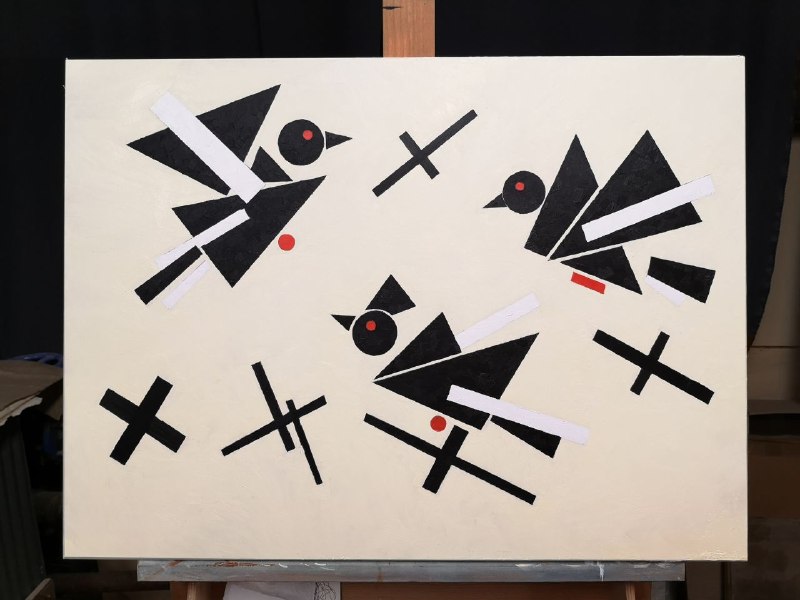
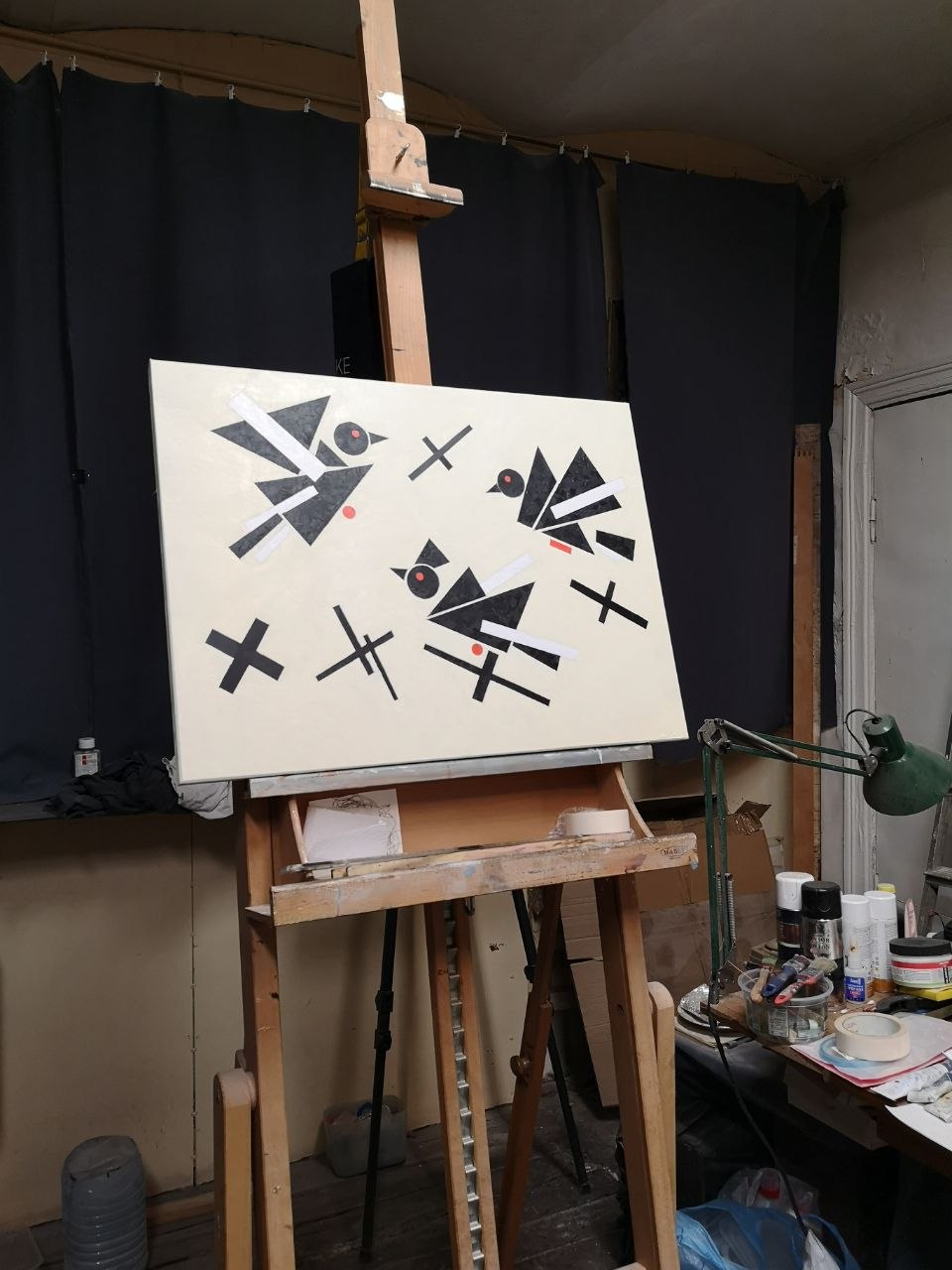
Иногда мне кажется, что эту работу сделал не я, а какое-то упрямое пересечение внутри меня — между желанием дойти до чистоты формы и невозможностью отпустить живое. Я начинал с почти аскетического намерения: белое поле, чёрные конструкции, никакой лишней интонации. Хотел приблизиться к состоянию, где форма существует сама по себе, без опоры на мир.
Но в какой-то момент в этой конструкции появились сороки.
Не как образ, не как иллюстрация — скорее как сбой. Чёрные треугольники вдруг начали складываться в крылья, круги — в головы, линии — в траектории движения. И я понял, что это уже не геометрия в чистом виде. Это что-то, что хочет жить.
Сорока — странная птица. Она некрасивая и красивая одновременно. Она шумная, наглая, внимательная, всегда на границе между порядком и хаосом. И, наверное, именно поэтому она так точно легла в супрематическую структуру. Потому что супрематизм — это тоже про границу: между предметом и отсутствием предмета, между миром и его исчезновением.
Белое поле здесь для меня не космос в строгом смысле. Оно слишком тёплое, слишком земное. Это снег. Пространство, где всё упрощается до предела, но не исчезает. Где любой след становится событием. И в этом поле сороки не просто существуют — они оставляют знаки, пересечения, почти орнамент своего присутствия.
Эти чёрные перекрестия я долго не мог принять. Они казались слишком буквальными, слишком «узнаваемыми». Но со временем я увидел, что без них всё распадается. Они удерживают ритм, собирают разлёт форм, как каркас, как память о структуре внутри движения. И одновременно они отсылают к чему-то глубоко знакомому — к вышивке, к знаку, к жесту руки, которая повторяет крест снова и снова.
Красные точки появились почти случайно, но стали неизбежными. Это минимальное вмешательство жизни в систему. Почти ничто — и при этом центр внимания. Без них работа оставалась бы холодной, замкнутой в себе. С ними она начинает смотреть обратно.
Я всё больше думаю, что эта картина не про супрематизм и не про птиц. Она про невозможность довести абстракцию до конца. Про то, что в какой-то момент форма начинает сопротивляться чистоте и требует присутствия. Требует шума, следа, взгляда.
И, возможно, в этом есть что-то очень личное и очень общее одновременно: сколько бы мы ни стремились к ясности и пустоте, внутри всегда остаётся сорока — которая приносит случайную блестящую вещь и нарушает идеальный порядок.
“Suprematist Magpies”
Sometimes it feels to me that this work was not made by me, but by some stubborn intersection within me — between the desire to reach purity of form and the inability to let go of the living. I began with an almost ascetic intention: a white field, black constructions, no unnecessary intonation. I wanted to approach a state where form exists on its own, without support from the world.
But at some point, magpies appeared within this structure.
Not as an image, not as an illustration — more like a glitch. Black triangles suddenly began to assemble into wings, circles into heads, lines into trajectories of movement. And I understood that this was no longer geometry in its pure form. It was something that wants to live.
The magpie is a strange bird. It is ugly and beautiful at the same time. It is loud, bold, attentive, always on the border between order and chaos. And perhaps that is exactly why it fits so precisely into a suprematist structure. Because Suprematism is also about a boundary: between object and the absence of object, between the world and its disappearance.
The white field here is not space in a strict sense for me. It is too warm, too earthly. It is snow. A space where everything is reduced to the limit, but does not disappear. Where any trace becomes an event. And in this field, magpies do not simply exist — they leave signs, intersections, almost an ornament of their presence.
I struggled for a long time to accept these black crossings. They seemed too literal, too “recognizable.” But over time I saw that without them everything disintegrates. They hold the rhythm, gather the scattering of forms like a frame, like a memory of structure within movement. And at the same time, they refer to something deeply familiar — to embroidery, to a sign, to the gesture of a hand repeating a cross again and again.
The red dots appeared almost by accident, but became inevitable. This is the minimal intervention of life into the system. Almost nothing — and at the same time the center of attention. Without them, the work would remain cold, closed in on itself. With them, it begins to look back.
I increasingly think that this painting is not about Suprematism and not about birds. It is about the impossibility of carrying abstraction to its end. About how, at some point, form begins to resist purity and demands presence. Demands noise, trace, gaze.
And perhaps there is something very personal and very universal in this: no matter how much we strive for clarity and emptiness, inside there is always a magpie — bringing a random shiny thing and disturbing the perfect order.

