New Barbarians

New Barbarians, a photo by Maxim/Max/Ksuta on Flickr.
New Barbarians, a photo by Maxim/Max/Ksuta on Flickr.

+ series – New Barabarians


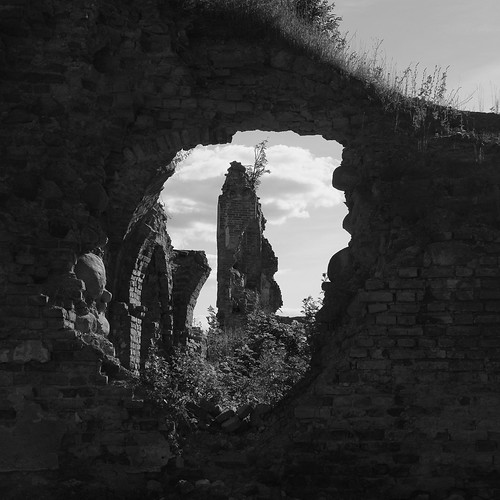
Руины Гольшанского замка.
Гольшанский замок (белор. Гальшанскі замак) — руины резиденции магнатского рода Сапег в деревне Гольшаны, Гродненская область, Беларусь. Он был построен в начале XVII века на месте более старой усадьбы княжеского рода Гольшанских.
Известный также как Чёрный замок (хотя построен из красного кирпича), в своё время он соперничал с Мирским замком за звание самого изысканного частного замка Великого княжества Литовского. Название «Чёрный замок» на самом деле первоначально относилось к вымышленному зданию из романа Владимира Короткевича, который лишь частично основывался на Гольшанском замке.
В 1704 году замок был сильно разрушен шведскими войсками во время Северной войны. Из-за тяжёлого финансового положения семьи Сапег после гражданской войны (Домашней войны) он так и не был восстановлен. После эмиграции Сапег во Францию замок перешёл к русскому помещику Горбанёву. В 1880 году он приказал разобрать башни замка и заработал на продаже кирпича.
В настоящее время замок продолжает постепенно разрушаться. Каждое лето у его стен проводится ежегодный рыцарский турнир.
The ruins of Halshany Castle.
Halshany Castle (Belarusian: Гальшанскі замак) is the ruined residence of the Sapieha magnate family in the village of Halshany, Hrodna Region, Belarus. It was built in the early 17th century on the site of an older seat of the Holszanski princely family.
Also known as the Black Castle (despite being constructed of red brick), it once rivaled Mir Castle as the most elegant private château in the Grand Duchy of Lithuania. In fact, the name “Black Castle” originally referred to a fictional building in a novel by Uladzimir Karatkievich, which was only loosely based on Halshany Castle.
The castle was badly damaged by Swedish troops during the Great Northern War in 1704. Due to the severe financial difficulties faced by the Sapieha family after the Lithuanian Civil War, it was never restored. After the Sapiehas emigrated to France, the castle passed to the Russian landowner Gorbanyov. In 1880, he ordered the towers to be demolished and made money by selling the bricks.
Today, the castle continues to crumble. Every summer, an annual knight tournament is held near its walls.



t HD audio-video-installation, Triumph gallery, Moscow 2013
Program: [Context of the visual]
Curators: [Vitaly Patsyukov], [Aliya Berdigaliyeva]
Coordinator: [Maria Punina]
Participants: [Leonid Tishkov], [Vladimir Tarasov], [Anna Ermolayeva], [Marina Chernikova], [Vladislav Efimov], [Vladimir Martynov], [Aristarkh Chernyshev], Dziga Vertov, Fernand Léger, Dudley Murphy, [Mikhail Tsekhanovsky], [Boris Yurtsev], [AES+F group], [Maxim Ksuta], [Nelya and Roman Korzhov], [Alexander Zaytsev], [Vladimir Logutov], [Social Adaptation group]
Organizers: NCCA Volga Branch, Samara Regional Public Charity Fund “Contemporary Art Centre”, ART-CENTRE Gallery SAMARA-CENTRE Ltd.
With the support of: RUSS OUTDOOR, VICTORYA Gallery, Moscow State Cinema Museum, XL Gallery, Triumph Gallery, Samara Regional Art Museum
Opening: May, 11, 7 pm
Place: Samara Art Centre (90, Michurina, Samara, Russia)
Coontacts: samara-center.ru/artcenter, +7 (846) 212-03-80, +7 (927) 604-33-05
This exhibition project, built on rare 1930s film footage and works by prominent contemporary artists, poses questions about the relationship of humans with man-made reality and the possibilities of self-identification through technology and production. Today, the humans’ attitude towards technology is consumerist. Perhaps it is because of the lack of direct contact with machines of production that the postindustrial man loses his positive attitude not only towards the mass-produced objects but also his own life which, much like machines and technology, is not under his control any longer.
Old Version … … … …


