News
2015 — The exhibition “Russian Chrestomathy”
NCCA, Nizhny Novgorod, Arsenal. Curator: Vera Pogodina
2015 — The exhibition “Sound Moebius Strip” exhibition (Belyaevo Gallery)
2015 — The exhibition “Russian Chrestomathy”
NCCA, Nizhny Novgorod, Arsenal. Curator: Vera Pogodina
2015 — The exhibition “Sound Moebius Strip” exhibition (Belyaevo Gallery)
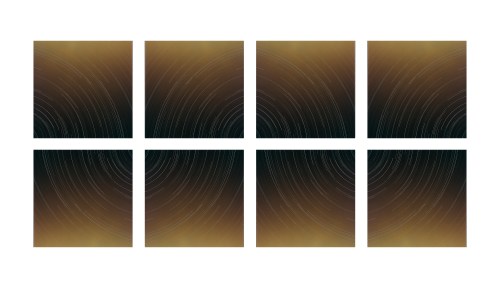
“Пятичасовое путешествие к созвездию Большой медведицы”, фото 445х215 см
“Five hours of travel in the constellation Ursa Major”, archive print, 445х215 см
“Embrace the boundless“
Impossible picture of the night sky
160х160 см
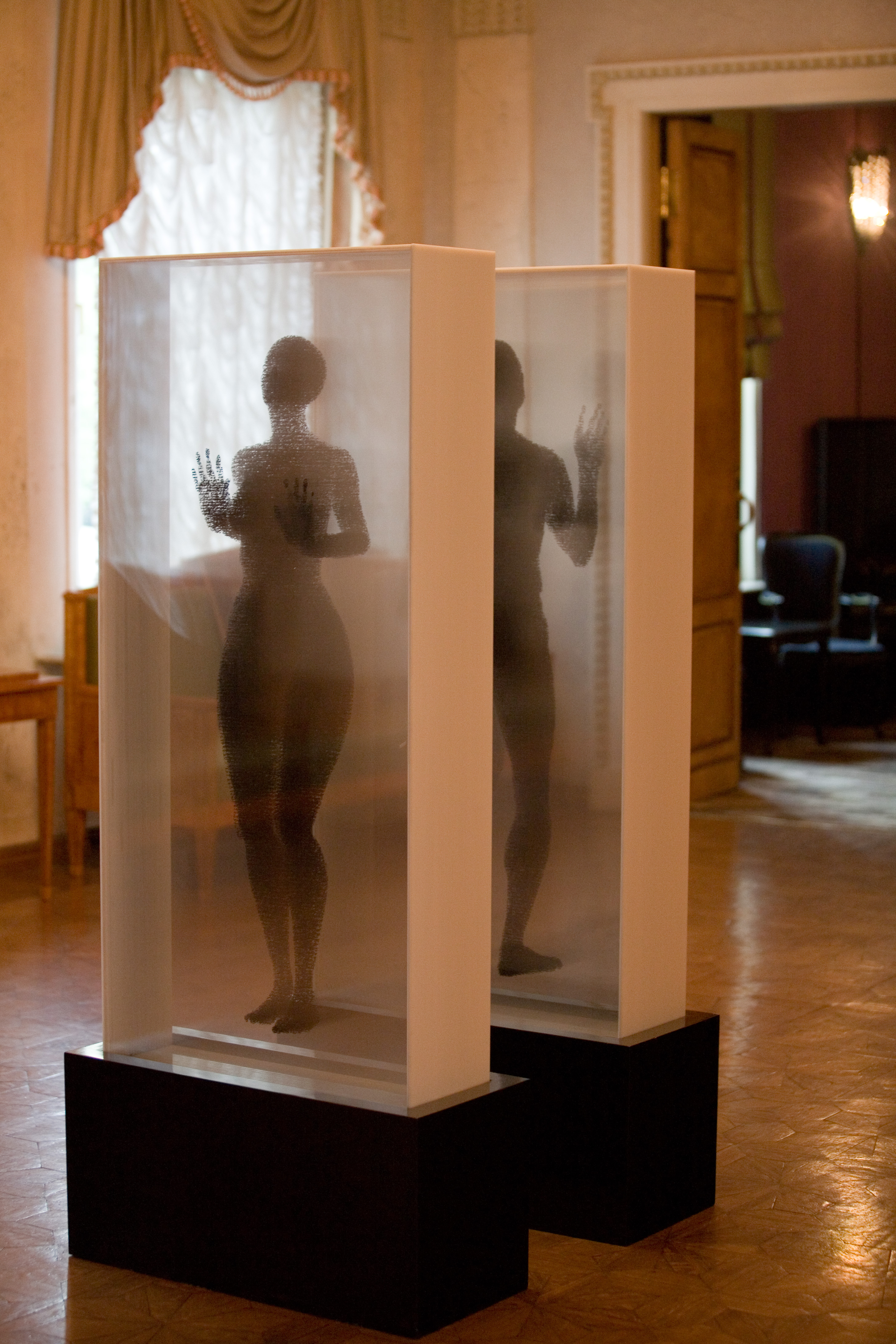
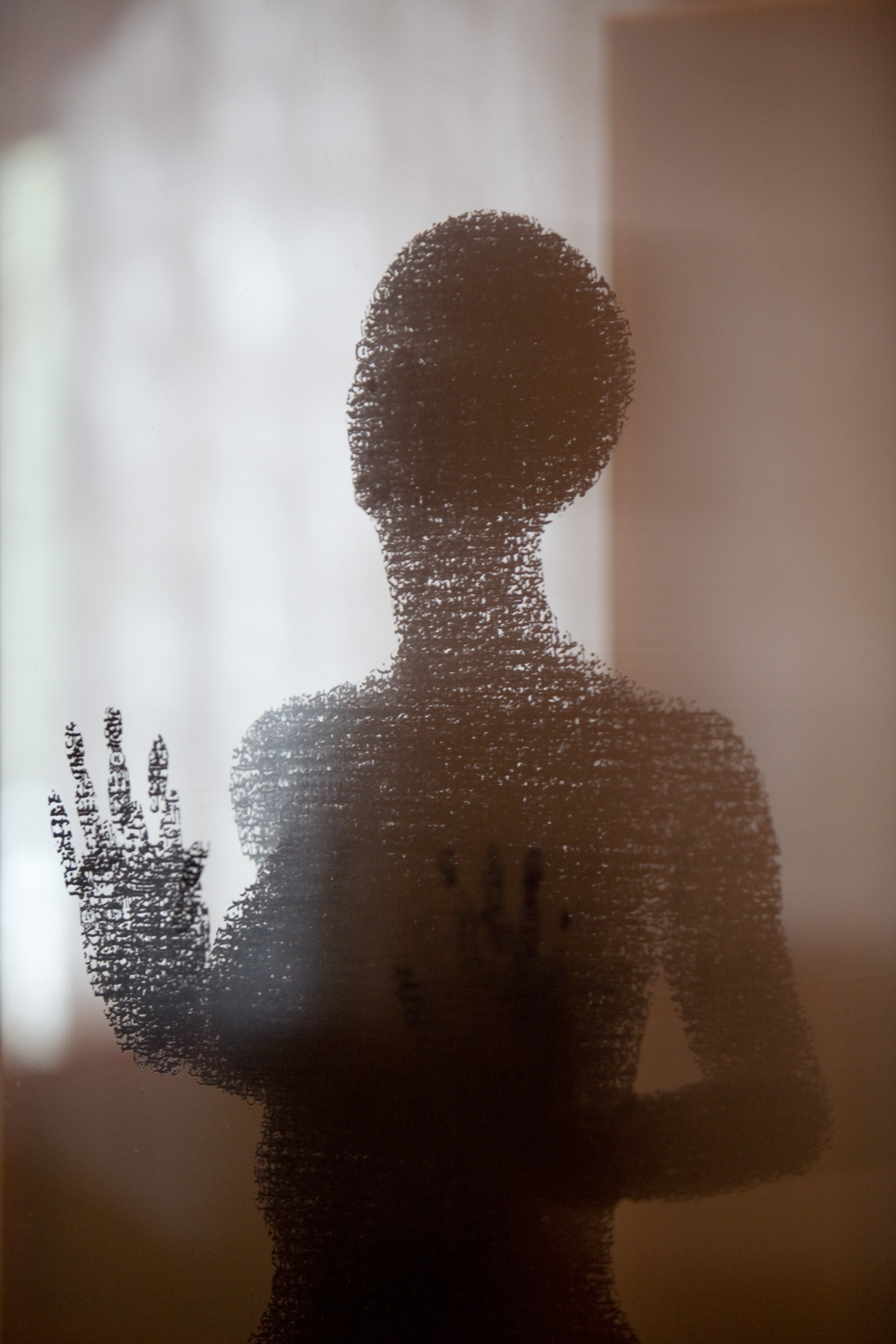
«Eve» – 25 trancperent acrylic glass layers. Oil solvent print Adam Eve (“Out of Eden”, Triumph gallery, Moscow, Russia 2006-2007)
Когда я создавал эту скульптуру, я думал о том, как история становится телом. Не метафорически – буквально. Я взял текст изгнания из рая и послойно напечатал его на двадцати пяти листах прозрачного акрила. Каждый слой, это фрагмент повествования, и только когда все они складываются вместе, возникает объём человеческой фигуры.
Я всегда чувствовал, что мы сотканы из историй, которые о нас рассказывают – или которые мы рассказываем о себе. Адам и Ева — первая история о человеке, и это история о потере, о переходе из одного состояния в другое. Мне хотелось показать, что эта история не просто о них – она есть они. Их тела не существуют отдельно от нарратива грехопадения.
Я выбрал масляную печать на акриле, потому что мне нужна была эта мерцающая, призрачная материальность. Фигуры должны были быть видимы, но не вполне присутствовать. Как воспоминание. Как то, что было и уже не может быть снова. Когда смотришь на скульптуру, она меняется в зависимости от освещения, от угла зрения – иногда фигуры почти растворяются, иногда становятся почти осязаемыми.
Работа с послойной структурой была для меня принципиальна. Это не монолитная форма – это археология смысла. Каждый слой текста добавляет не только объём, но и временную глубину. История грехопадения происходит не в одночасье – это последовательность событий, решений, последствий. И я хотел, чтобы это было видно в самой структуре скульптуры.
Вблизи фигура распадается на тысячи букв, становится нечитаемой. Нужно отойти на расстояние, чтобы увидеть человека. Это точная метафора того, как мы воспринимаем себя и других: слишком близко – и мы видим только детали, фрагменты, текст; нужна дистанция, чтобы увидеть целое, образ, личность.
Меня всегда поражал центральный момент библейской истории: “И открылись глаза у них обоих, и узнали они, что наги”. До грехопадения Адам и Ева были прозрачны друг для друга – в них не было ничего скрытого, ничего, что требовало бы прикрытия. После – они прячутся, шьют одежды из листьев, стыдятся своих тел.
Я вернул им прозрачность, но уже на другом уровне. Теперь они обнажены перед нами не в своей невинности, а в своей истории. Мы видим их насквозь – буквально, сквозь слои акрила и текста. Их прозрачность теперь не защита, а уязвимость. Они не могут спрятаться, не могут скрыть то, что с ними произошло.
Этот жест руки, прижатой к стеклу, возник почти случайно в процессе работы над композицией. Но когда я его увидел, понял, что это самое важное в скульптуре. Это превращает концептуальный объект в человеческое высказывание. Рука тянется к нам — или отталкивает нас, или просто касается границы своего мира.
Это жест узника, но и жест благословения. Жест отчаяния и жест надежды. Я оставил его неоднозначным, потому что само изгнание – неоднозначно. Да, это потеря рая. Но это и обретение свободы, знания, возможности выбора. Адам и Ева стали людьми в тот момент, когда перестали быть безгрешными.
Я настоял, чтобы эта работа была показана не в нейтральном белом пространстве, а в классическом интерьере. Золотые драпировки, паркет, лепнина – это мир, который построило человечество после изгнания. Мир культуры, власти, искусства, красоты. Мир, который возник как компенсация за утраченный Эдем.
И в этом мире стоят мои прозрачные фигуры на чёрных постаментах. Постаменты – единственное непрозрачное, тяжёлое, материальное в скульптуре. Они как якорь, удерживающий призрачные тела в нашей реальности. Без них фигуры просто растворились бы в свете.
Эта работа далась мне непросто – не технически, а эмоционально. Я вкладывал в неё что-то очень личное, хотя сюжет архетипический. Возможно, потому что история изгнания, это история о невозможности вернуться. О том, что некоторые переходы необратимы. Ты можешь помнить, как было раньше, можешь носить эту память в себе -но дороги назад нет.
Каждый из нас переживает своё изгнание из рая – моменты, после которых жизнь уже не может быть прежней. Первая потеря, первая боль, первое осознание собственной смертности. И эти моменты формируют нас – послойно, как текст на акриле, – в тех, кем мы становимся.
Но есть в этой скульптуре и надежда – хотя я не сразу это осознал. Прозрачность материала означает, что свет проходит сквозь фигуры. История, которая их формирует, не делает их непроницаемыми. Они пропускают свет. И в этом, мне кажется, главное послание работы: да, мы сотканы из наших историй, из наших падений и изгнаний, но мы не сводимся к ним. Свет проходит насквозь.
Акрил может треснуть, выцвести, раствориться. Эти тела не вечны – как не вечны бронза или мрамор традиционной скульптуры, только их хрупкость более очевидна. И в этой хрупкости — их человечность. Адам и Ева у меня не герои, не боги, не идеалы. Они просто первые люди, застывшие в момент перехода, видимые сквозь слои собственной истории.
Наверное, я хотел создать скульптуру о том, как мы себя помним и как нас помнят. О том, что личность, это не твёрдое ядро, а слоистая структура из опыта, историй, слов. О том, что невозможность вернуться не означает невозможности трансформации.
И ещё я хотел, чтобы зритель, глядя на эти фигуры, испытал то же чувство, что испытываю я, работая с ними: странную смесь печали и нежности. Они так уязвимы, эти прозрачные тела. Они так беззащитны перед нашим взглядом. И в то же время в них есть достоинство – достоинство тех, кто принял свою историю, кто несёт её в себе, не отрекаясь и не сгибаясь под её тяжестью.
When I created this sculpture, I was thinking about how history becomes body. Not metaphorically—literally. I took the text of the expulsion from paradise and printed it layer by layer on twenty-five sheets of transparent acrylic. Each layer is a fragment of the narrative, and only when they all come together does the volume of a human figure emerge.
I have always felt that we are woven from the stories told about us—or that we tell about ourselves. Adam and Eve are the first story about humanity, and it is a story of loss, of transition from one state to another. I wanted to show that this story is not simply about them—it is them. Their bodies do not exist separately from the narrative of the fall.
I chose oil solvent print on acrylic because I needed this shimmering, ghostly materiality. The figures had to be visible but not quite present. Like a memory. Like something that was and can never be again. When you look at the sculpture, it changes depending on the lighting, on the angle of view—sometimes the figures almost dissolve, sometimes they become almost tangible.
Working with the layered structure was fundamental for me. This is not a monolithic form—it is an archaeology of meaning. Each layer of text adds not only volume but temporal depth. The story of the fall does not happen in an instant—it is a sequence of events, decisions, consequences. And I wanted this to be visible in the very structure of the sculpture.
Up close, the figure disintegrates into thousands of letters, becomes unreadable. You need to step back to see the human. This is a precise metaphor for how we perceive ourselves and others: too close—and we see only details, fragments, text; distance is needed to see the whole, the image, the person.
I have always been struck by the central moment of the biblical story: “And the eyes of them both were opened, and they knew that they were naked.” Before the fall, Adam and Eve were transparent to each other—there was nothing hidden in them, nothing that required covering. Afterward—they hide, sew garments from leaves, feel shame about their bodies.
I returned transparency to them, but on a different level now. Now they are exposed before us not in their innocence, but in their history. We see through them—literally, through layers of acrylic and text. Their transparency now is not protection but vulnerability. They cannot hide, cannot conceal what happened to them.
This gesture of a hand pressed against the glass emerged almost by chance in the process of working on the composition. But when I saw it, I understood that this was the most important thing in the sculpture. It transforms a conceptual object into a human statement. The hand reaches toward us—or pushes us away, or simply touches the boundary of its world.
It is the gesture of a prisoner, but also the gesture of blessing. A gesture of despair and a gesture of hope. I left it ambiguous because the expulsion itself is ambiguous. Yes, it is the loss of paradise. But it is also the acquisition of freedom, knowledge, the possibility of choice. Adam and Eve became human the moment they ceased to be sinless.
I insisted that this work be shown not in a neutral white space but in a classical interior. Golden draperies, parquet, molding—this is the world that humanity built after the expulsion. A world of culture, power, art, beauty. A world that arose as compensation for the lost Eden.
And in this world stand my transparent figures on black pedestals. The pedestals are the only opaque, heavy, material element in the sculpture. They are like an anchor, holding the ghostly bodies in our reality. Without them, the figures would simply dissolve in the light.
This work was not easy for me—not technically, but emotionally. I was putting something very personal into it, even though the subject is archetypal. Perhaps because the story of expulsion is a story about the impossibility of return. About the fact that some transitions are irreversible. You can remember how it was before, you can carry that memory within you—but there is no way back.
Each of us experiences our own expulsion from paradise—moments after which life can never be the same. The first loss, the first pain, the first awareness of one’s own mortality. And these moments shape us—layer by layer, like text on acrylic—into who we become.
But there is hope in this sculpture too—though I didn’t realize it immediately. The transparency of the material means that light passes through the figures. The history that shapes them does not make them impenetrable. They let light through. And in this, I think, is the main message of the work: yes, we are woven from our stories, from our falls and expulsions, but we are not reducible to them. Light passes through.
Acrylic can crack, fade, dissolve. These bodies are not eternal—no more than bronze or marble of traditional sculpture, only their fragility is more obvious. And in this fragility lies their humanity. My Adam and Eve are not heroes, not gods, not ideals. They are simply the first people, frozen in a moment of transition, visible through the layers of their own history.
I suppose I wanted to create a sculpture about how we remember ourselves and how we are remembered. About the fact that personality is not a solid core but a layered structure of experience, stories, words. About the fact that the impossibility of return does not mean the impossibility of transformation.
And I also wanted the viewer, looking at these figures, to experience the same feeling I experience working with them: a strange mixture of sadness and tenderness. They are so vulnerable, these transparent bodies. They are so defenseless before our gaze. And at the same time, there is dignity in them—the dignity of those who have accepted their history, who carry it within themselves, neither renouncing it nor bending under its weight.
Before / Прежде
After / После
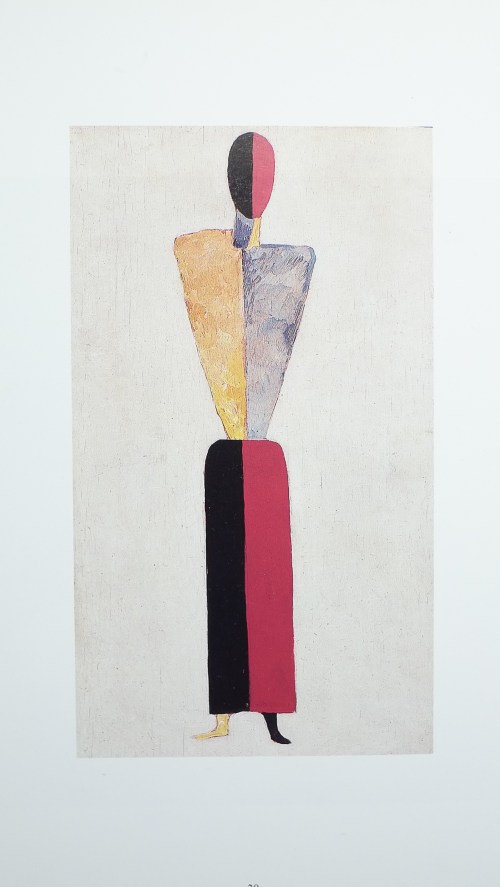
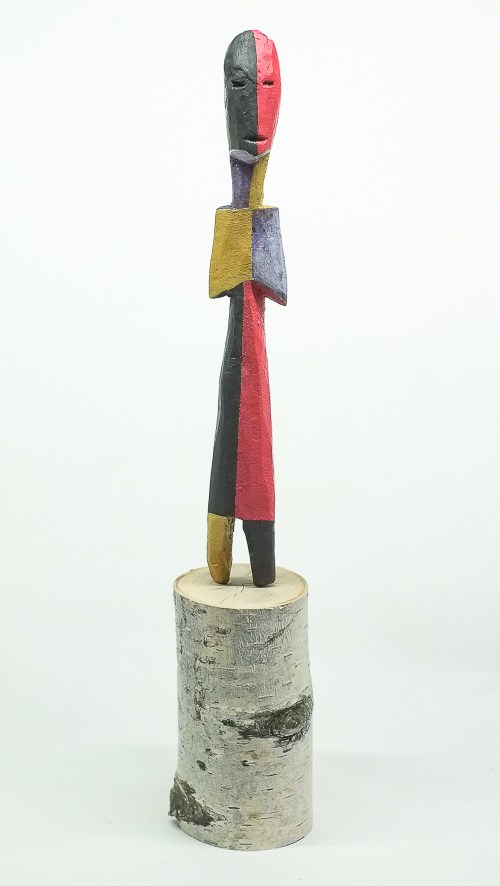
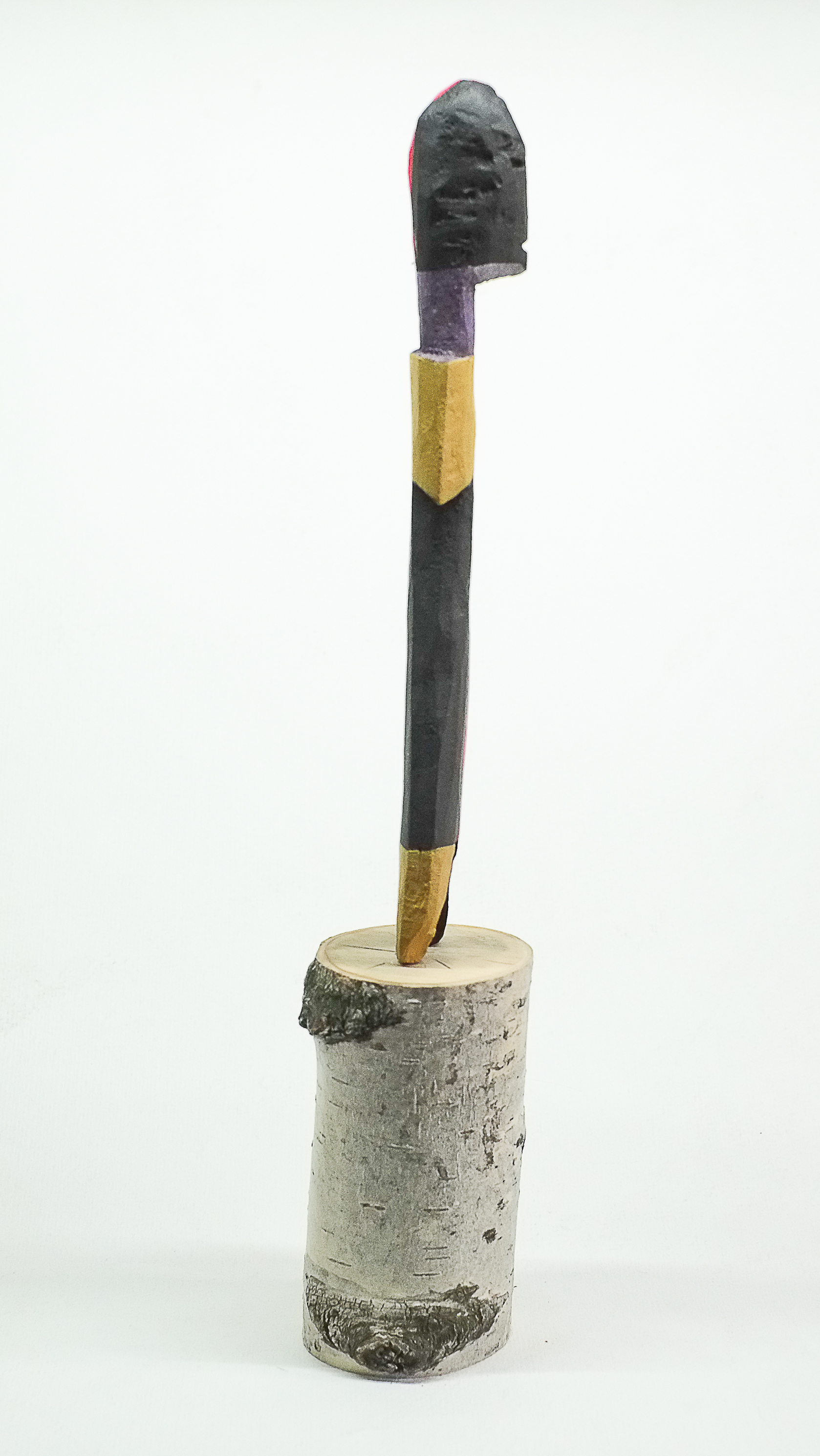
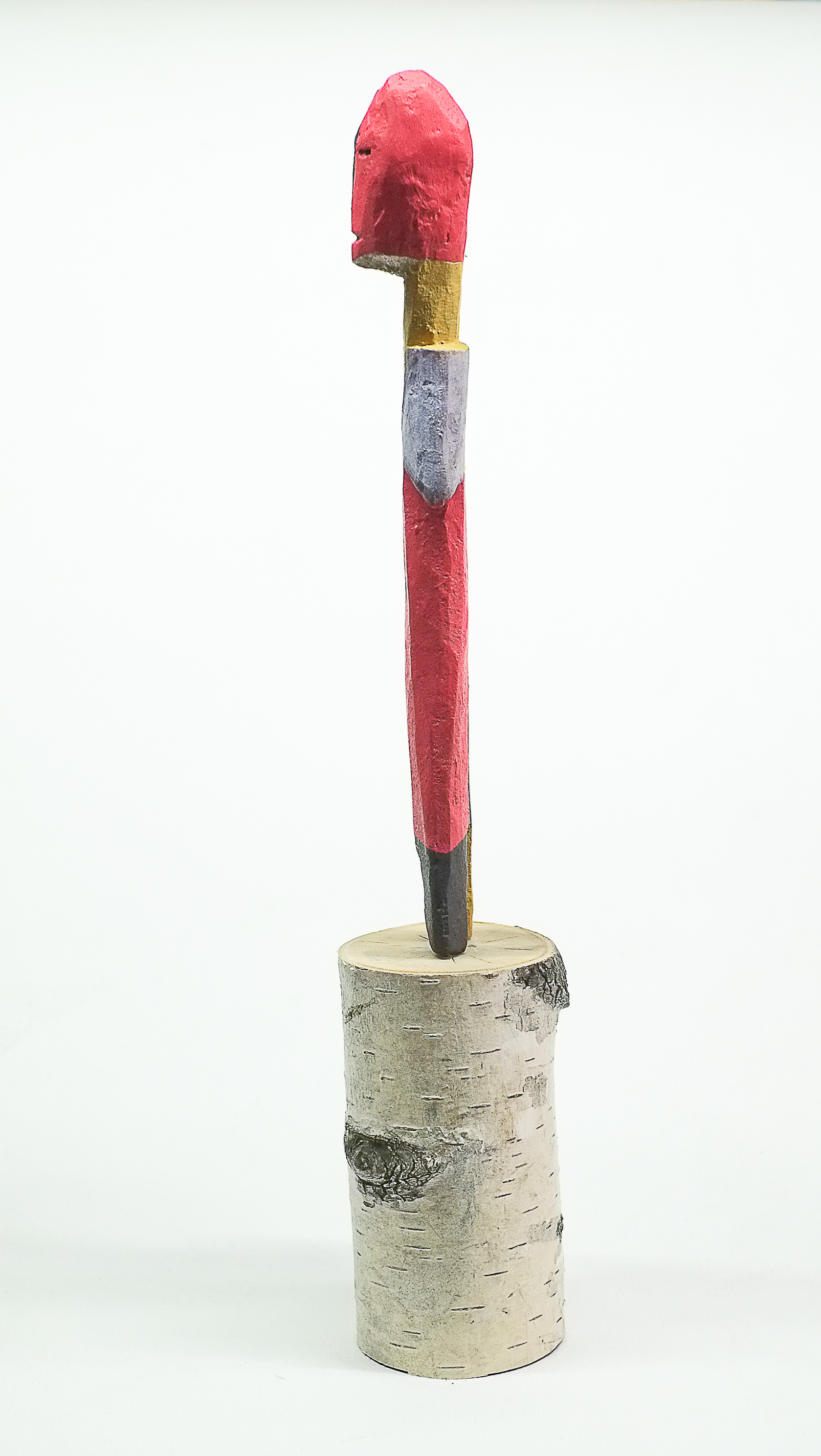
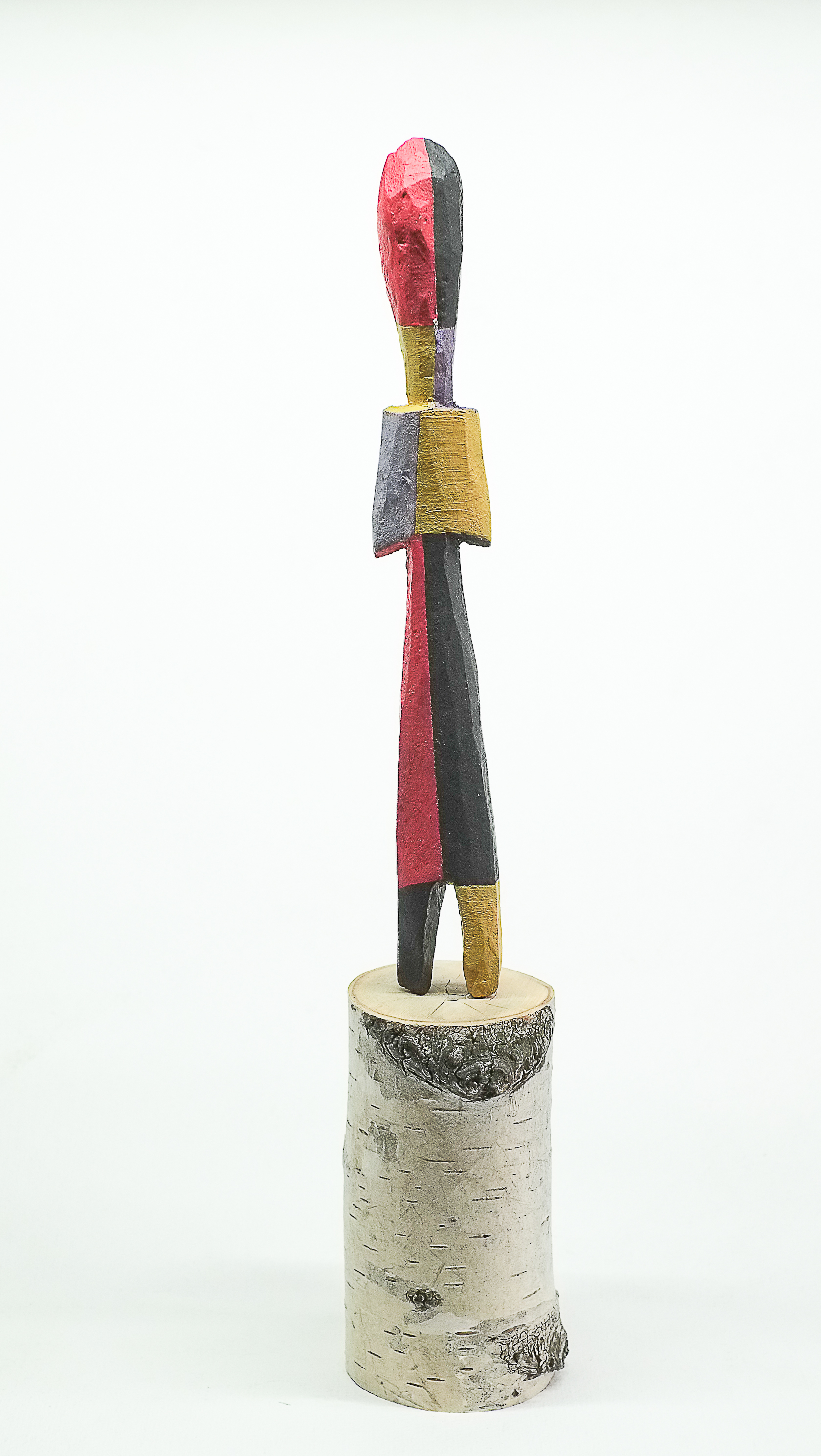
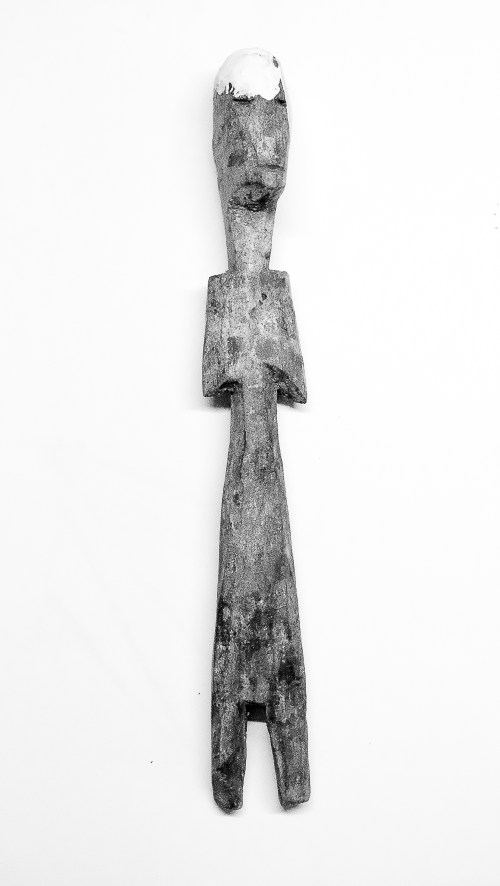
Серия «Африка Малевича» является свидетельством того, что искусство может существовать вне времени и границ. Эти работы — не просто живопись, а мост между двумя культурами, двумя эпохами и двумя художественными традициями.
Серия «Африка Малевича» представляет собой уникальный диалог культур, в котором русский авангард супрематизма встречается с древними пластическими традициями африканской скульптуры.
В основе проекта лежит принцип художественного перекодирования: аутентичная африканская деревянная фигура становится «носителем» визуального языка Малевича. С помощью акриловой краски и опираясь на хроматическую логику супрематического портрета, этнографический объект трансформируется в произведение современного искусства, объединяя два измерения — ритуально-магическое и авангардное.
Эта практика не только ставит под вопрос представления об оригинальности и авторстве, но и выявляет универсальность художественного знака. Линии и цветовые поля Малевича органично ложатся на ритмы африканской скульптуры, словно подтверждая идею глобальной абстрактной формы, выходящей за пределы времени и географии.
Таким образом, серия «Африка Малевича» становится одновременно актом культурного мостостроительства и исследованием границ эстетической идентичности. Здесь традиция обретает новый голос, а авангард — новое тело.
Дерево, акрил
34,5 × 6,5 × 6 см
The series Malevich’s Africa demonstrates how art can exist beyond time and borders. These works are not merely paintings, but a bridge between cultures, epochs, and artistic traditions.
At its core, the project unfolds as a dialogue between Russian Suprematism and the ancient plastic language of African sculpture.
The key principle here is artistic recoding: an authentic African wooden figure becomes the carrier of Malevich’s visual system. Through the use of acrylic paint and guided by the chromatic logic of the Suprematist portrait, the ethnographic object is transformed into a contemporary artwork, merging two dimensions — the ritual and the avant-garde.
This approach challenges conventional notions of originality and authorship while revealing the universality of artistic sign-making. Malevich’s lines and planes integrate seamlessly with the rhythms of African sculpture, suggesting the presence of a global abstract language that transcends both time and geography.
Thus, Malevich’s Africa operates simultaneously as an act of cultural translation and as an inquiry into the limits of aesthetic identity. Here, tradition acquires a new voice, while the avant-garde is given a new body.
Wood, acrylic
34.5 × 6.5 × 6 cm

I`am, Wolfgang Gantner, Ustina Yakovleva – my exhibition 15 may 2014 Triumph gallery
Topsy-Turvy
16.05.2014 – 01.06.2014, Triumph gallery


Максим Ксута, пожалуй, единственный российский художник, который от проекта к проекту последовательно исследует технические и технологические возможности фотографии: в центре его интереса находится не столько само фотографическое изображение (кажется, Ксута не о самом образе и его внушающей силе), сколько манипуляции с полученным изображением, разложение фотографического процесса на отдельные стадии и чрезвычайно разнообразные механические деконструкции изображения, чтобы затем из артефактов, возникающих в результате этой деконструкции, заново собрать целое, переупорядочить распавшиеся части и установить новые связи. Ксута играет с реальностью, используя её как своего рода конструктор, словно её можно подвергнуть базовой реконструкции по воле играющего; при этом им движет ещё одно важное обстоятельство, которое в той или иной форме проявлялось уже в самых ранних его работах. Ксута принципиально не согласен с видимой реальностью: не согласен в том смысле, что неизбежно стремится обнаружить в ней симметрию и порядок, визуальную логику, которая даже в своих несовершенствах позволяет нам увидеть красоту. Он постоянно ищет структуру, часто изобретает её, «навязывает» её пейзажам, людям, объектам; внедряет каркас в массу случайных зрительных впечатлений.
Аналогичным образом, в своём проекте для Triumph Gallery Ксута «очищает» реальность, демонстрируя в пространстве базовый фотографический принцип позитив/негатив. При этом он различает одно состояние от другого едва заметной, почти прозрачной границей. Для Ксуты образ границы, раздела, чрезвычайно важен — это особое пространство, вокруг и внутри которого сосредоточено всё существующее, и реальность (как будто столкнувшись с опасностью) приобретает предельно концентрированную форму; граница — это проявление сущности, её пересечение всегда является символическим актом изменения состояния, и Ксута умело работает с этим в пространстве галереи.
Проект «Topsy-Turvy» (ироничное название нисколько не умаляет серьёзности замысла) возвращает зрителя к ещё одному важному для истории фотографии вопросу: где начинается и где заканчивается её объективность и «правдивость», насколько различаются видимая и фотографическая реальности? Часто повторяющиеся сомнения в способности фотографии отражать происходящее или существующее (наиболее отчётливо это проявляется в работах художников дюссельдорфской школы) находят новое выражение в проекте Максима Ксуты. Он не стремится проникнуть в сущность реальности и не пытается уловить мимолётность движения или равновесие цвета; вместо этого он сосредотачивается на сущности самой фотографии, на фотографическом процессе, разлагая изображение на позитив и негатив, беспощадно обнажая его структуру. Ксуту не привлекает визионерское — его интересует лабораторный подход, использование серьёзного научного аппарата и соответствующих инструментов. И именно в этом проявляется подлинная этика художника — честность жеста, целостность программы, которая позволяет не только создавать новые фотографические серии, но и мыслить пространством, физическими объёмами, в которых происходят удивительные переходы и трансформации.
Екатерина Иноземцева
Мой проект полностью посвящён осмыслению удивительной технологии, открытой около 150 лет назад и ставшей в последнее время повседневной благодаря своему массовому распространению как удобного инструмента передачи информации. Я попытался выявить и обозначить выразительные семантические и пространственные акценты, формирующие как сам процесс, так и дискурс вокруг современной фотографии.
Серия работ следует принципу, согласно которому опыт современного искусства основан на противоречии, нонконформизме и тезисе, утверждающем, что каждый следующий шаг отвергает предыдущий. В связи с этим я продолжаю эксперимент по изменению «состояния равновесия фотографии», выводя её из сферы документального отражения событий в пространство атмосферного и сугубо чувственного.
Представляя проект как site-specific-инсталляцию, я стремлюсь вовлечь зрителя в пространство произведения, активизируя его чувствительность. «Граница раздела» — это основной концептуальный вектор, вокруг которого выстраивается композиция проекта. Конструктивными элементами выступают прямой негатив и крупномасштабные фотографические накопления. Почему именно «граница»?
Понятие «границы» открывает широкий спектр направлений и смысловых векторов. Граница и маргинальность — области, недостаточно глубоко исследованные в рамках фотографического процесса. Фотография столь объективна, что эта «сверхреальность» жёстко связывает нас со стереотипами интерпретации, сковывая воображение. Тем не менее именно граница между «негативом» и «позитивом» принципиально связывает понятия «до» и «после».
Ключевую роль в инсталляции играет разворачивающийся сюжет путешествия между реальностями, каждая из которых объективна, поскольку прошла через объектив и была зафиксирована, однако они качественно различаются по содержанию, будучи элементами мира и антимира — и кому или чему принадлежит та или иная сторона, предстоит решить зрителю.
Максим Ксута


Maxim Ksuta is perhaps the only Russian artist who, from project to project, consistently explores the technical and technological capacities of photography. His interest lies not so much in the photographic image itself (Ksuta is not concerned with the image and its suggestive qualities), but in the manipulation of the resulting image, in breaking the photographic process down into discrete stages, and in a wide range of mechanical deconstructions of the image. From the artifacts produced by this deconstruction, he reconstructs a new whole, reorders fragmented elements, and establishes new connections.
Ksuta plays with reality as if it were a construction set, something that can be fundamentally reassembled at will. At the same time, he is driven by another important impulse that can already be traced in his earliest works. Ksuta is fundamentally at odds with visible reality — in the sense that he persistently seeks symmetry and order within it, a visual logic that, even in its imperfections, reveals beauty. He is constantly searching for structure; often he invents it, “imposes” it upon landscapes, people, and objects, embedding a skeletal framework into the mass of случайных visual impressions.
In his project for Triumph Gallery, Ksuta similarly “purifies” reality, demonstrating in space the fundamental photographic principle of positive and negative. He distinguishes one state from another by means of an almost imperceptible, nearly transparent boundary. For Ksuta, the notion of a boundary or division is crucial: it is a special space within and around which everything exists, and where reality, as if under threat, acquires an intense, concentrated form. The boundary manifests essence; crossing it becomes a symbolic act of transformation, something Ksuta skillfully stages within the gallery space.
The project Topsy-Turvy (an ironic title that does not diminish the seriousness of the undertaking) returns the viewer to a key question in the history of photography: where do its objectivity and “truthfulness” begin and end? How far apart are visible reality and photographic reality? Persistent doubts about photography’s ability to represent what exists — most clearly articulated in the work of the Düsseldorf School — find a renewed expression in Ksuta’s project.
Rather than seeking the essence of reality or attempting to capture fleeting movement or chromatic balance, Ksuta focuses on the essence of photography itself — on the photographic process. He breaks the image down into positive and negative, relentlessly exposing its structure. He is not drawn to the visionary; instead, he is committed to a laboratory-based approach, employing precise technical apparatus and tools. It is precisely here that the artist’s ethic becomes evident: the honesty of the gesture and the coherence of the program, enabling not only the creation of new photographic series but also a mode of thinking through space — through physical volumes where remarkable transitions and transformations occur.
Ekaterina Inozemtseva


My project is entirely devoted to reflecting on a remarkable technology discovered approximately 150 years ago, which has recently become ubiquitous due to its widespread use as a convenient means of conveying information. I set out to identify and articulate the key semantic and spatial emphases that shape both the photographic process itself and the discourse surrounding contemporary photography.
The series follows the principle that the experience of modern art is grounded in contradiction, nonconformity, and the idea that each successive step negates the previous one. In this context, I continue my experiment in shifting the “state of equilibrium” of photography, moving it from the realm of documentary representation into the domain of the atmospheric and the purely sensory.
By presenting the project as a site-specific installation, I aim to involve the viewer within the spatial situation, thereby heightening perceptual sensitivity. The “boundary of division” serves as the central conceptual axis around which the composition is constructed. The primary structural elements are the direct negative and large-scale photographic accumulations. Why the “boundary”?
The concept of the boundary opens up a wide range of interpretive directions and conceptual vectors. Boundary and marginality remain insufficiently explored within photographic practice. Photography’s apparent objectivity creates a kind of “hyper-reality” that binds us to interpretive stereotypes, constraining the imagination. Yet it is precisely the boundary between negative and positive that fundamentally links the notions of “before” and “after.”
A key role in the installation is played by the unfolding narrative of a journey between realities. Each is objective, having passed through the lens and been recorded, yet they differ qualitatively in content, existing as elements of a world and an anti-world. Which side belongs to whom or to what is left for the viewer to determine.
Maxim Ksuta
Via … … … …