Adam Eve (“Out of Eden”, Triumph gallery, Moscow, Russia 2006-2007)
by maxksuta
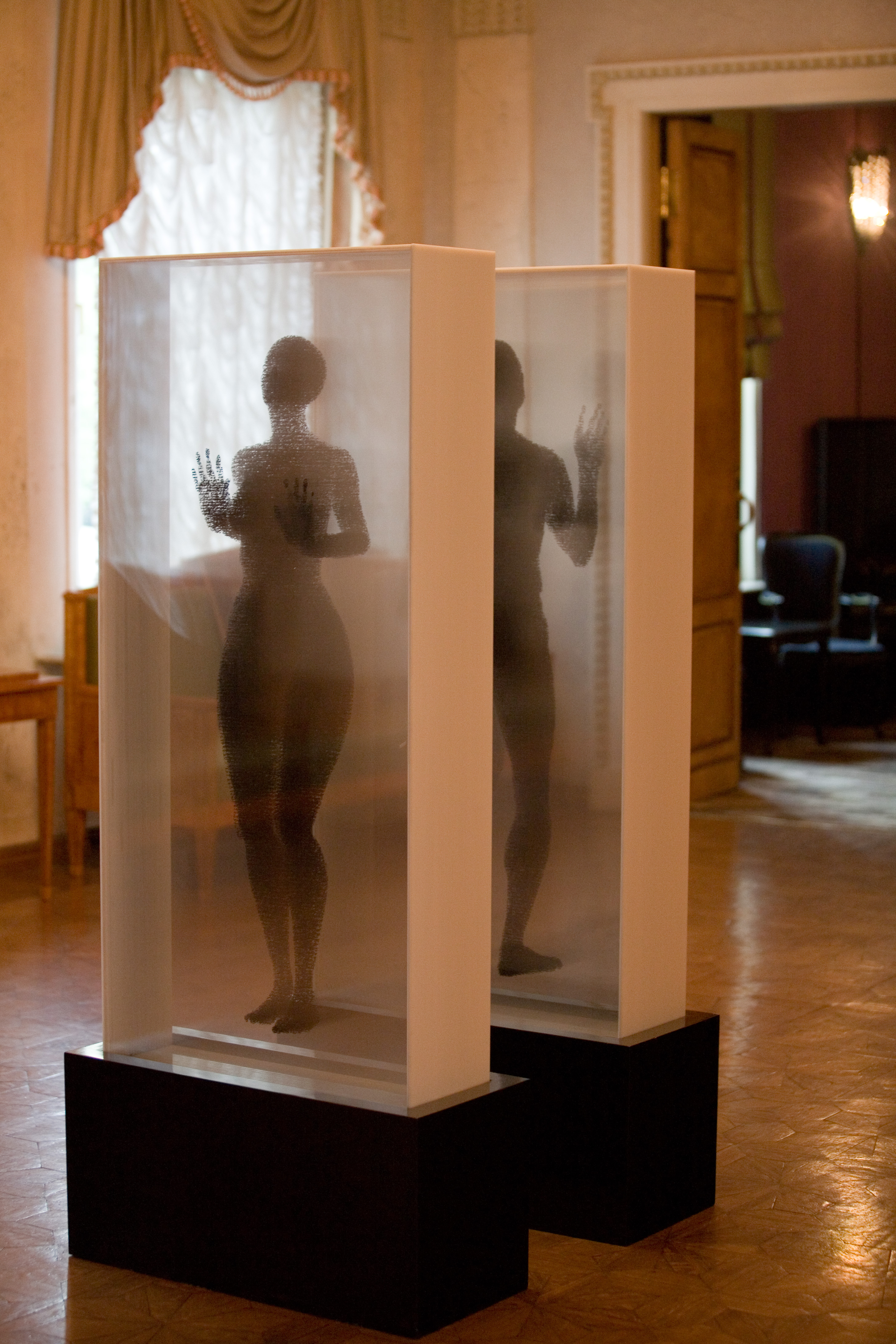
«Eve» – 25 trancperent acrylic glass layers. Oil solvent print Adam Eve (“Out of Eden”, Triumph gallery, Moscow, Russia 2006-2007)
Между словом и плотью
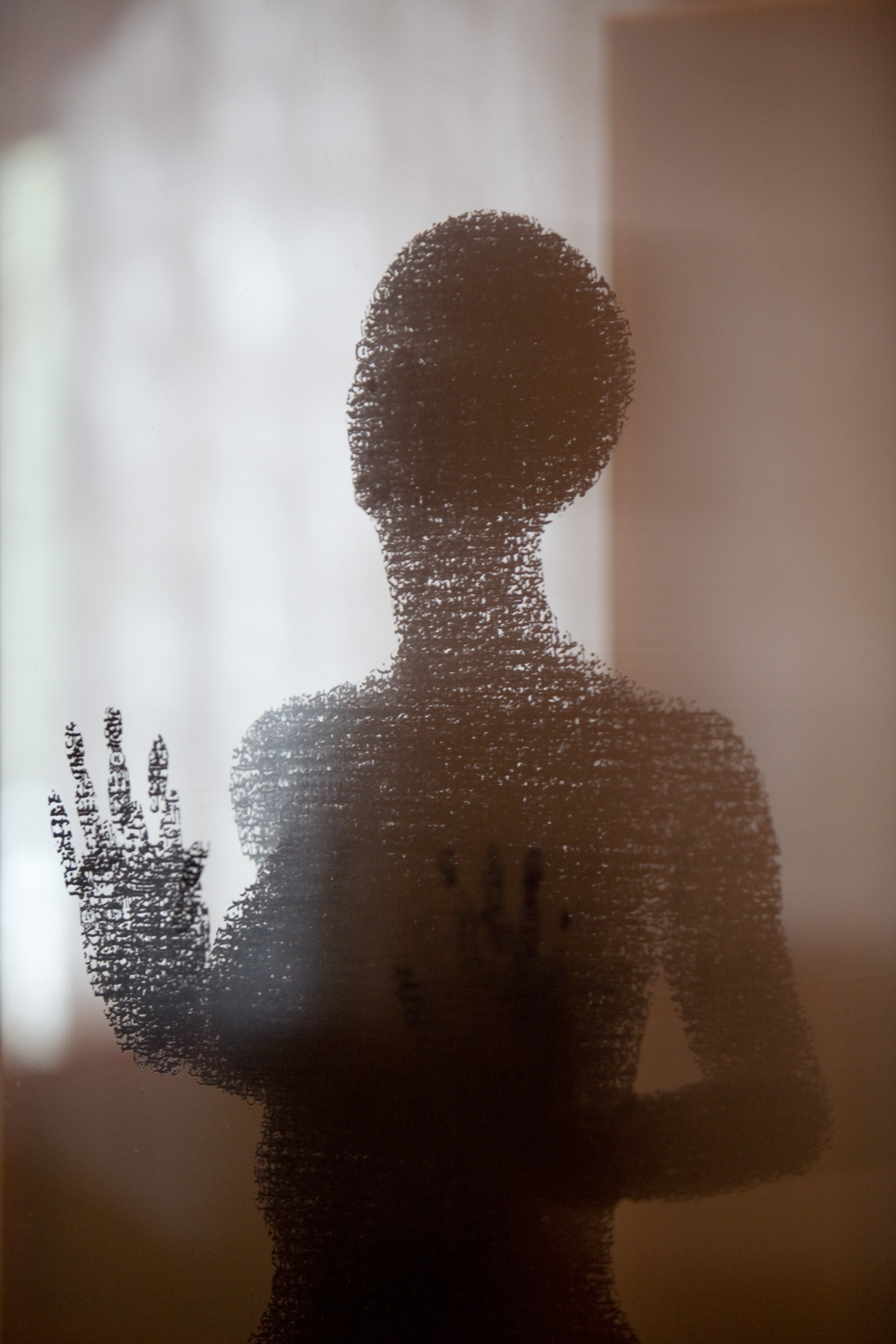
Когда я создавал эту скульптуру, я думал о том, как история становится телом. Не метафорически – буквально. Я взял текст изгнания из рая и послойно напечатал его на двадцати пяти листах прозрачного акрила. Каждый слой, это фрагмент повествования, и только когда все они складываются вместе, возникает объём человеческой фигуры.
Текст как плоть
Я всегда чувствовал, что мы сотканы из историй, которые о нас рассказывают – или которые мы рассказываем о себе. Адам и Ева — первая история о человеке, и это история о потере, о переходе из одного состояния в другое. Мне хотелось показать, что эта история не просто о них – она есть они. Их тела не существуют отдельно от нарратива грехопадения.
Я выбрал масляную печать на акриле, потому что мне нужна была эта мерцающая, призрачная материальность. Фигуры должны были быть видимы, но не вполне присутствовать. Как воспоминание. Как то, что было и уже не может быть снова. Когда смотришь на скульптуру, она меняется в зависимости от освещения, от угла зрения – иногда фигуры почти растворяются, иногда становятся почти осязаемыми.
Двадцать пять слоёв памяти
Работа с послойной структурой была для меня принципиальна. Это не монолитная форма – это археология смысла. Каждый слой текста добавляет не только объём, но и временную глубину. История грехопадения происходит не в одночасье – это последовательность событий, решений, последствий. И я хотел, чтобы это было видно в самой структуре скульптуры.
Вблизи фигура распадается на тысячи букв, становится нечитаемой. Нужно отойти на расстояние, чтобы увидеть человека. Это точная метафора того, как мы воспринимаем себя и других: слишком близко – и мы видим только детали, фрагменты, текст; нужна дистанция, чтобы увидеть целое, образ, личность.
Прозрачность и стыд
Меня всегда поражал центральный момент библейской истории: “И открылись глаза у них обоих, и узнали они, что наги”. До грехопадения Адам и Ева были прозрачны друг для друга – в них не было ничего скрытого, ничего, что требовало бы прикрытия. После – они прячутся, шьют одежды из листьев, стыдятся своих тел.
Я вернул им прозрачность, но уже на другом уровне. Теперь они обнажены перед нами не в своей невинности, а в своей истории. Мы видим их насквозь – буквально, сквозь слои акрила и текста. Их прозрачность теперь не защита, а уязвимость. Они не могут спрятаться, не могут скрыть то, что с ними произошло.
Жест
Этот жест руки, прижатой к стеклу, возник почти случайно в процессе работы над композицией. Но когда я его увидел, понял, что это самое важное в скульптуре. Это превращает концептуальный объект в человеческое высказывание. Рука тянется к нам — или отталкивает нас, или просто касается границы своего мира.
Это жест узника, но и жест благословения. Жест отчаяния и жест надежды. Я оставил его неоднозначным, потому что само изгнание – неоднозначно. Да, это потеря рая. Но это и обретение свободы, знания, возможности выбора. Адам и Ева стали людьми в тот момент, когда перестали быть безгрешными.
Пространство
Я настоял, чтобы эта работа была показана не в нейтральном белом пространстве, а в классическом интерьере. Золотые драпировки, паркет, лепнина – это мир, который построило человечество после изгнания. Мир культуры, власти, искусства, красоты. Мир, который возник как компенсация за утраченный Эдем.
И в этом мире стоят мои прозрачные фигуры на чёрных постаментах. Постаменты – единственное непрозрачное, тяжёлое, материальное в скульптуре. Они как якорь, удерживающий призрачные тела в нашей реальности. Без них фигуры просто растворились бы в свете.
Что я чувствовал, работая над этим
Эта работа далась мне непросто – не технически, а эмоционально. Я вкладывал в неё что-то очень личное, хотя сюжет архетипический. Возможно, потому что история изгнания, это история о невозможности вернуться. О том, что некоторые переходы необратимы. Ты можешь помнить, как было раньше, можешь носить эту память в себе -но дороги назад нет.
Каждый из нас переживает своё изгнание из рая – моменты, после которых жизнь уже не может быть прежней. Первая потеря, первая боль, первое осознание собственной смертности. И эти моменты формируют нас – послойно, как текст на акриле, – в тех, кем мы становимся.
Свет сквозь историю
Но есть в этой скульптуре и надежда – хотя я не сразу это осознал. Прозрачность материала означает, что свет проходит сквозь фигуры. История, которая их формирует, не делает их непроницаемыми. Они пропускают свет. И в этом, мне кажется, главное послание работы: да, мы сотканы из наших историй, из наших падений и изгнаний, но мы не сводимся к ним. Свет проходит насквозь.
Акрил может треснуть, выцвести, раствориться. Эти тела не вечны – как не вечны бронза или мрамор традиционной скульптуры, только их хрупкость более очевидна. И в этой хрупкости — их человечность. Адам и Ева у меня не герои, не боги, не идеалы. Они просто первые люди, застывшие в момент перехода, видимые сквозь слои собственной истории.
Почему я это сделал
Наверное, я хотел создать скульптуру о том, как мы себя помним и как нас помнят. О том, что личность, это не твёрдое ядро, а слоистая структура из опыта, историй, слов. О том, что невозможность вернуться не означает невозможности трансформации.
И ещё я хотел, чтобы зритель, глядя на эти фигуры, испытал то же чувство, что испытываю я, работая с ними: странную смесь печали и нежности. Они так уязвимы, эти прозрачные тела. Они так беззащитны перед нашим взглядом. И в то же время в них есть достоинство – достоинство тех, кто принял свою историю, кто несёт её в себе, не отрекаясь и не сгибаясь под её тяжестью.
Between Word and Flesh
When I created this sculpture, I was thinking about how history becomes body. Not metaphorically—literally. I took the text of the expulsion from paradise and printed it layer by layer on twenty-five sheets of transparent acrylic. Each layer is a fragment of the narrative, and only when they all come together does the volume of a human figure emerge.
Text as Flesh
I have always felt that we are woven from the stories told about us—or that we tell about ourselves. Adam and Eve are the first story about humanity, and it is a story of loss, of transition from one state to another. I wanted to show that this story is not simply about them—it is them. Their bodies do not exist separately from the narrative of the fall.
I chose oil solvent print on acrylic because I needed this shimmering, ghostly materiality. The figures had to be visible but not quite present. Like a memory. Like something that was and can never be again. When you look at the sculpture, it changes depending on the lighting, on the angle of view—sometimes the figures almost dissolve, sometimes they become almost tangible.
Twenty-Five Layers of Memory
Working with the layered structure was fundamental for me. This is not a monolithic form—it is an archaeology of meaning. Each layer of text adds not only volume but temporal depth. The story of the fall does not happen in an instant—it is a sequence of events, decisions, consequences. And I wanted this to be visible in the very structure of the sculpture.
Up close, the figure disintegrates into thousands of letters, becomes unreadable. You need to step back to see the human. This is a precise metaphor for how we perceive ourselves and others: too close—and we see only details, fragments, text; distance is needed to see the whole, the image, the person.
Transparency and Shame
I have always been struck by the central moment of the biblical story: “And the eyes of them both were opened, and they knew that they were naked.” Before the fall, Adam and Eve were transparent to each other—there was nothing hidden in them, nothing that required covering. Afterward—they hide, sew garments from leaves, feel shame about their bodies.
I returned transparency to them, but on a different level now. Now they are exposed before us not in their innocence, but in their history. We see through them—literally, through layers of acrylic and text. Their transparency now is not protection but vulnerability. They cannot hide, cannot conceal what happened to them.
The Gesture
This gesture of a hand pressed against the glass emerged almost by chance in the process of working on the composition. But when I saw it, I understood that this was the most important thing in the sculpture. It transforms a conceptual object into a human statement. The hand reaches toward us—or pushes us away, or simply touches the boundary of its world.
It is the gesture of a prisoner, but also the gesture of blessing. A gesture of despair and a gesture of hope. I left it ambiguous because the expulsion itself is ambiguous. Yes, it is the loss of paradise. But it is also the acquisition of freedom, knowledge, the possibility of choice. Adam and Eve became human the moment they ceased to be sinless.
The Space
I insisted that this work be shown not in a neutral white space but in a classical interior. Golden draperies, parquet, molding—this is the world that humanity built after the expulsion. A world of culture, power, art, beauty. A world that arose as compensation for the lost Eden.
And in this world stand my transparent figures on black pedestals. The pedestals are the only opaque, heavy, material element in the sculpture. They are like an anchor, holding the ghostly bodies in our reality. Without them, the figures would simply dissolve in the light.
What I Felt Working on This
This work was not easy for me—not technically, but emotionally. I was putting something very personal into it, even though the subject is archetypal. Perhaps because the story of expulsion is a story about the impossibility of return. About the fact that some transitions are irreversible. You can remember how it was before, you can carry that memory within you—but there is no way back.
Each of us experiences our own expulsion from paradise—moments after which life can never be the same. The first loss, the first pain, the first awareness of one’s own mortality. And these moments shape us—layer by layer, like text on acrylic—into who we become.
Light Through History
But there is hope in this sculpture too—though I didn’t realize it immediately. The transparency of the material means that light passes through the figures. The history that shapes them does not make them impenetrable. They let light through. And in this, I think, is the main message of the work: yes, we are woven from our stories, from our falls and expulsions, but we are not reducible to them. Light passes through.
Acrylic can crack, fade, dissolve. These bodies are not eternal—no more than bronze or marble of traditional sculpture, only their fragility is more obvious. And in this fragility lies their humanity. My Adam and Eve are not heroes, not gods, not ideals. They are simply the first people, frozen in a moment of transition, visible through the layers of their own history.
Why I Made This
I suppose I wanted to create a sculpture about how we remember ourselves and how we are remembered. About the fact that personality is not a solid core but a layered structure of experience, stories, words. About the fact that the impossibility of return does not mean the impossibility of transformation.
And I also wanted the viewer, looking at these figures, to experience the same feeling I experience working with them: a strange mixture of sadness and tenderness. They are so vulnerable, these transparent bodies. They are so defenseless before our gaze. And at the same time, there is dignity in them—the dignity of those who have accepted their history, who carry it within themselves, neither renouncing it nor bending under its weight.

